MCQ
A body starts from rest with uniform acceleration. If its velocity after $n$ second is $\upsilon ,$ then its displacement in the last two seconds is
  • A
    $\frac{{2\upsilon \left( {n + 1} \right)}}{n}$
  • B
    $\frac{{\upsilon \left( {n + 1} \right)}}{n}$
  • C
    $\frac{{\upsilon \left( {n - 1} \right)}}{n}$
  • $\frac{{2\upsilon \left( {n - 1} \right)}}{n}$
Answer

Correct option: D.
$\frac{{2\upsilon \left( {n - 1} \right)}}{n}$
d
(d) Now, distance travelled in $n$ sec. ==> ${S_n} = \frac{1}{2}a{n^2}$and distance travelled in $(n - 2)\sec $==>${S_{n - 2}} = \frac{1}{2}a{(n - 2)^2}$

$\therefore$ Distance travelled in last two seconds,

$ = {S_n} - {S_{n - 2}}$$ = \frac{1}{2}a{n^2} - \frac{1}{2}a{(n - 2)^2}$

$ = \frac{a}{2}\left[ {{n^2} - {{(n - 2)}^2}} \right]$$ = \frac{a}{2}[n + (n - 2)][n - (n - 2)]$

=$a(2n - 2)$ $ = \frac{v}{n}(2n - 2)$$ = \frac{{2v(n - 1)}}{n}$

Need a full question paper?

Generate a complete, print-ready paper with questions like this in minutes — across 16+ boards, with answer keys.

Start Generating Free

Similar questions

A convex lens makes a real image $4 cm$ long on a screen. When the lens is shifted to a new position without disturbing the object, we again get a real image on the screen which is $16 cm$ tall. The length of the object must be.......$cm$
The current in a coil decreases from $1 \,A$ to $0.2\, A$. In $10\,sec$. Calculate the coefficient of self inductance. If induced $e.m.f.$ is $0.4\, volt$......$H$
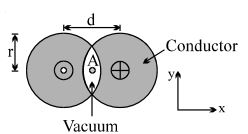
Two long conductors are arranged as shown above to form overlapping cylinders, each of raidus $r$, whose centers are separated by a distance $d$. Current of density $J$ flows into the plane of the page along the shaded part of one conductor and an equal current flows out of the plane of the page along the shaded portion of the other, as shown. What are the magnitude and direction of the magnetic field at point  $A?$
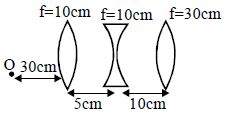
Find the position of image with respect to right most lens formed by the lens combination.....$cm$
A projectile is thrown with velocity $U=20\ m/s ± 5\%$ at an angle $60^o.$ If the projectile falls back on the ground at the same level then    ......... $m$ of following can not be a possible answer for range.
A uniform cylinder of length $L$ and mass $M$ having crosssectional area $A$ is suspended, with its length vertical, from a fixed point by a massless spring such that it is half submerged in a liquid of density $\sigma$ at equilibrium position. The extension $x_0$ of the spring when it is in equilibrium is
In the circuit shown in figure
In an alpha particle scattering experiment distance of closest approach for the $\alpha$ particle is $4.5 \times 10^{-14} \mathrm{~m}$. If target nucleus has atomic number $80$ , then maximum velocity of $\alpha$-particle is . . . . .. $\times 10^5$ $\mathrm{m} / \mathrm{s}$ approximately.

$\left(\frac{1}{4 \pi \in_0}=9 \times 10^9 \mathrm{SI}\right.$ unit, mass of $\alpha$ particle $=$ $\left.6.72 \times 10^{-27} \mathrm{~kg}\right)$

If force $\vec{F}=3 \hat{i}+4 \hat{j}-2 \hat{k}$ acts on a particle having position vector $2 \hat{i}+\hat{j}+2 \hat{k}$ then, the torque about the origin will be
The moment of inertia of semicircular plate of radius $R$ and mass $M$ about axis $AA’$ in its plane passing through its centre is