A body takes $5$ minute to cool from $80°C$ to $50°C$ . ...... $\min.$ it will take to cool from $60°C$ to $30°C$ , if room temperature is $20°C$ .
Medium


Download our appand get started for free
Experience the future of education. Simply download our apps or reach out to us for more information. Let's shape the future of learning together!No signup needed.*
Similar Questions
- 1The intensity of radiation emitted by the sun has its maximum value at a wavelength of $510\;nm$ and that emitted by the north star has the maximum value at $350\;nm$. If these stars behave like black bodies, then the ratio of the surface temperature of the sun and north star isView Solution
- 2In the Ingen Hauz’s experiment the wax melts up to lengths $10$ and $25 cm$ on two identical rods of different materials. The ratio of thermal conductivities of the two materials isView Solution
- 3View SolutionIn a closed room, heat transfer takes place by
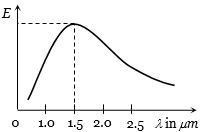
- 4In the figure, the distribution of energy density of the radiation emitted by a black body at a given temperature is shown. The possible temperature of the black body is ....... $K$View Solution
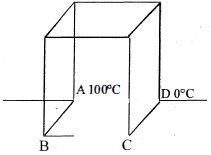
- 5Find Temperature difference between $B$ and $C$ ? (All rods are identical)View Solution
- 6Two rods, one made of copper and the other steel of the same length and cross-sectional area are joined together. The thermal conductivity of copper is $385 \,Js ^{-1} m ^{-1} K ^{-1}$ and steel is $50 \,Js ^{-1} m ^{-1} K ^{-1}$. If the copper end is held at $100^{\circ} C$ and the steel end is held at $0^{\circ} C$, the junction temperature is ........... $C$ (Assuming no other heat losses)View Solution
- 7View SolutionWoollen clothes are used in winter season because woolen clothes
- 8Which of the following circular rods. (given radius $ r$ and length $l$ ) each made of the same material as whose ends are maintained at the same temperature will conduct most heatView Solution
- 9Two thermometers $A$ and $B$ are exposed in sun light. The valve of $A$ is painted black, But that of $B$ is not painted. The correct statement regarding this case isView Solution
- 10Two spheres made of same material have radii in the ratio $1: 2$ Both are at same temperature. Ratio of heat radiation energy emitted per second by them isView Solution