MCQ
A body travels $102.5 \mathrm{~m}$ in $\mathrm{n}^{\text {th }}$ second and $115.0 \mathrm{~m}$ in $(n+2)^{\text {th }}$ second. The acceleration is :
  • A
     $9 \mathrm{~m} / \mathrm{s}^2$
  • $6.25 \mathrm{~m} / \mathrm{s}^2$
  • C
    $12.5 \mathrm{~m} / \mathrm{s}^2$
  • D
    $5 \mathrm{~m} / \mathrm{s}^2$

Answer

Correct option: B.
$6.25 \mathrm{~m} / \mathrm{s}^2$
b
Given, $102.5=\mathrm{u}+\frac{\mathrm{a}}{2}(2 \mathrm{n}-1) \&$

$115=\mathrm{u}+\frac{\mathrm{a}}{2}(2 \mathrm{n}+3)$

$\Rightarrow 102.5=\mathrm{u}+\mathrm{an}-\frac{\mathrm{a}}{2} \&$

$115=\mathrm{u}+\mathrm{an}+\frac{3 \mathrm{a}}{2}$

$12.5=2 \mathrm{a} \Rightarrow \mathrm{a}=6.25 \mathrm{~m} / \mathrm{s}^2$

Hence option $(2)$

Need a full question paper?

Generate a complete, print-ready paper with questions like this in minutes — across 16+ boards, with answer keys.

Start Generating Free

Similar questions

A bomb of mass $9\, kg$ explodes into two pieces of masses $3\, kg$ and $6\, kg$. The velocity of mass $3\, kg$ is $16\, m/s$. The $KE$ of mass $6\, kg$ is ............ $\mathrm{J}$
A ball thrown by one player reaches the other in $2\, sec$. The maximum height attained by the ball above the point of projection will be about .......... $m$
A particle moves in $\mathrm{x}-\mathrm{y}$ plane under the influence of a force $\vec{F}$ such that its linear momentum is $\vec{P}(t)=\hat{i} \cos (k t)-\hat{j} \sin (k t)$. If $k$ is constant, the angle between $\overrightarrow{\mathrm{F}}$ and $\overrightarrow{\mathrm{P}}$ will be :
The same retarding force is applied to stop a train. The train stops after $80\, m$. If the speed is doubled, then the stopping distance will be
A particle starting from rest and moves with constant acceleration travels a distance $x$ in first $2$ seconds and a distance $y$ in next two seconds, then
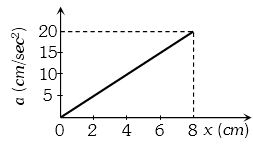
A 10kg mass moves along $x-$axis. Its acceleration as a function of its position is shown in the figure. What is the total work done on the mass by the force as the mass moves from $x = 0$ to $x = 8\,cm$
A bullet of mass $10 \,g$ moving with a speed of $20 \,m / s$ hits an ice block of mass $990 \,g$ kept on a frictionless floor and gets stuck in it. How much ice will melt if $50 \%$ of the lost KE goes to ice is .......... $g$ (initial temperature of the ice block and bullet $=0^{\circ} C$ )
A car is moving along a straight line, say $OP$ in given figure. It moves from $O$ to $P$ in $18\; s$ and returns from $P$ to $\mathrm{Q}$ in $6.0\; s$. What are the average velocity and average speed of the car in going from $O$ to $P$?
The work done by all the forces $($external and internal$)$ on a system equals the change in:
Which one of the following does not have the same dimensions