MCQ
A body with mass 5kg is acted upon by a force $\text{F}=(-3\hat{\text{i}}+4\hat{\text{j}})\text{N.}$ If its initial velocity at t = 0 is $\text{v}=(6\hat{\text{i}}-12\hat{\text{j}})\text{m s}^{-1},$ the time at which it will just have a velocity along the y-axis is:
  • A
    never
  • 10s
  • C
    2s
  • D
    15s

Answer

Correct option: B.
10s
According to the problam, mass m = 5kg
Force which is acting uppon the block $\vec{\text{F}}=(-3\hat{\text{i}}+4\hat{\text{j}})\text{N}$
Inital velocity at $\text{t}=0,\ \vec{\text{u}}=(6\vec{\text{i}}-12\vec{\text{j}})\text{m/s}$
Retardation, $\vec{\text{a}}=\frac{\vec{\text{F}}}{\text{m}}=\Big(-\frac{3\vec{\text{i}}}{5}+\frac{4\vec{\text{j}}}{5}\Big)\text{m/s}^2$
And when final veocity is along y-axis only, its x-componet must be zero.
We have to apply kinematic wquations seprately for x-component only. then we get $\text{v}_\text{x}=\text{u}_\text{x}+\text{a}_\text{x}\text{t}$
$0= 6\vec{\text{i}}-\frac{3\vec{\text{i}}}{5}\text{t}$
$\text{t}=\frac{5\times6}{3}=10\ \text{s}$

Need a full question paper?

Generate a complete, print-ready paper with questions like this in minutes — across 16+ boards, with answer keys.

Start Generating Free

Similar questions

A block of mass $m$ is placed on a smooth horizontal surface. A force making an angle $\theta$ with the horizontal starts acting on the block. The magnitude of the force is constant but its direction with the horizontal changes as $\theta = a+ bs$, where $a$ and $b$ are constants and $s$ is the distance covered by the block. If $|F| = 2mb$, find the velocity of the block as function of the angle $\theta$ .
The displacement of a particle after time $t$ is given by $x = \left( {k/{b^2}} \right)\left( {1 - {e^{ - bt}}} \right)$ where $b$ is a constant. What is the acceleration of the particle? 
A body takes $5$ minute to cool from $80°C$ to $50°C$ .  ...... $\min.$ it will take to cool from $60°C$ to $30°C$ , if room temperature is $20°C$ .
A given system undergoes a change in which work done by the system equals the decrease in its internal energy. The system must have undergone:
Wave equations of two particles are given by ${y_1} = a\sin (\omega \,t - kx)$, ${y_2} = a\sin (kx + \omega \,t)$, then
A particle moves in a circle of radius $5 \;cm$ with constant speed and time period $0.2 \pi\; sec$. The acceleration of the particle is .... $m/sec^2$
A small ball is projected up a smooth inclined plane with an initial speed of $10\ m/s$ along the direction at $30^o $ to the bottom edge of the slope. It returns to the edge after $2\, s$. The ball is in contact with the inclined plane throughout the process. ....... $^o$ is the inclination angle of the plane.
Two particles having position vectors $\overrightarrow {{r_1}} = (3\hat i + 5\hat j)$ metres and $\overrightarrow {{r_2}} = ( - 5\hat i - 3\hat j)$ metres are moving with velocities ${\overrightarrow v _1} = (4\hat i + 3\hat j)\,m/s$ and ${\overrightarrow v _2} = (\alpha \,\hat i + 7\hat j)$ $m/s.$ If they collide after $2$  seconds, the value of $'\alpha '$ is
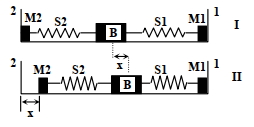
A block $(B)$ is attached to two unstretched springs $\mathrm{S} 1$ and $\mathrm{S} 2$ with spring constants $\mathrm{k}$ and $4 \mathrm{k}$, respectively (see figure $\mathrm{I}$ ). The other ends are attached to identical supports $M1$ and $M2$ not attached to the walls. The springs and supports have negligible mass. There is no friction anywhere. The block $\mathrm{B}$ is displaced towards wall $1$ by a small distance $\mathrm{x}$ (figure $II$) and released. The block returns and moves a maximum distance $\mathrm{y}$ towards wall $2$ . Displacements $\mathrm{x}$ and $\mathrm{y}$ are measured with respect to the equilibrium position of the block $B$. The ratio $\frac{y}{x}$ is Figure: $Image$
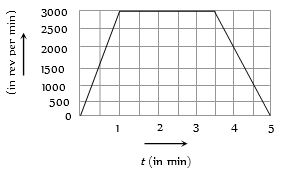
As a part of a maintenance inspection the compressor of a jet engine is made to spin according to the graph as shown. The number of revolutions made by the compressor during the test is