MCQ
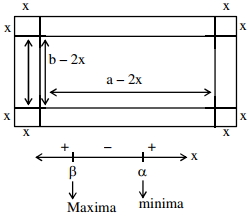
A box open from top is made from a rectangular sheet of dimension $\mathrm{a} \times \mathrm{b}$ by cutting squares each of side $x$ from each of the four corners and folding up the flaps. If the volume of the box is maximum, then $\mathrm{x}$ is equal to :
  • A
    $\frac{a+b-\sqrt{a^{2}+b^{2}-a b}}{12}$
  • B
    $\frac{a+b-\sqrt{a^{2}+b^{2}+a b}}{6}$
  • $\frac{a+b-\sqrt{a^{2}+b^{2}-a b}}{6}$
  • D
    $\frac{a+b+\sqrt{a^{2}+b^{2}-a b}}{6}$

Answer

Correct option: C.
$\frac{a+b-\sqrt{a^{2}+b^{2}-a b}}{6}$
c
$\mathrm{V}=\ell . \mathrm{b} \cdot \mathrm{h}=(\mathrm{a}-2 \mathrm{x})(\mathrm{b}-2 \mathrm{x}) \mathrm{x}$

$\Rightarrow \mathrm{V}(\mathrm{x})=(2 \mathrm{x}-\mathrm{a})(2 \mathrm{x}-\mathrm{b}) \mathrm{x}$

$\Rightarrow \mathrm{V}(\mathrm{x})=4 \mathrm{x}^{3}-2(\mathrm{a}+\mathrm{b}) \mathrm{x}^{2}+\mathrm{abx}$

$\Rightarrow \frac{\mathrm{d}}{\mathrm{dx}} \mathrm{v}(\mathrm{x})=12 \mathrm{x}^{2}-4(\mathrm{a}+\mathrm{b}) \mathrm{x}+\mathrm{ab}$

$\frac{\mathrm{d}}{\mathrm{dx}}(\mathrm{v}(\mathrm{x}))=0 \Rightarrow 12 \mathrm{x}^{2}-4(\mathrm{a}+\mathrm{b}) \mathrm{x}+\mathrm{ab}=0<_{\beta}^{\alpha}$

$\Rightarrow \mathrm{x}=\frac{4(\mathrm{a}+\mathrm{b}) \pm \sqrt{16(\mathrm{a}+\mathrm{b})^{2}-48 \mathrm{ab}}}{2(12)}$

$=\frac{(a+b) \pm \sqrt{a^{2}+b^{2}-a b}}{6}$

Let $\mathrm{x}=\alpha=\frac{(\mathrm{a}+\mathrm{b})+\sqrt{\mathrm{a}^{2}+\mathrm{b}^{2}-\mathrm{ab}}}{\frac{6}{\mathrm{~d}}}$

$\beta=\frac{(\mathrm{a}+\mathrm{b})-\sqrt{\mathrm{a}^{2}+\mathrm{b}^{2}-\mathrm{ab}}}{6}$

Now, $12(\mathrm{x}-\alpha)(\mathrm{x}-\beta)=0$

$\therefore \mathrm{x}=\beta$

$=\frac{\mathrm{a}+\mathrm{b}-\sqrt{\mathrm{a}^{2}+\mathrm{b}^{2}-\mathrm{ab}}}{\mathrm{b}}$
Need a full question paper?

Generate a complete, print-ready paper with questions like this in minutes — across 16+ boards, with answer keys.

Start Generating Free

Similar questions

If a line makes the angle $\alpha ,\beta ,\gamma $ with three dimensional co-ordinate axes respectively, then $\cos 2\alpha + \cos 2\beta + \cos 2\gamma = $
The number of diagonals in a octagon will be
The curvilinear trapezoid is bounded by the curve $y = x^2 + 1$ and the straight lines $x=1$ and $x=2.$ The co-ordinates of the point ( on the given curve) with abscissa $x\in [1,2]$ where tangent drawn cut off from the curvilinear trapezoid an ordinary trapezium of the greatest area, is
$\cos \theta \left[ {\begin{array}{*{20}{c}}{\cos \theta }&{\sin \theta }\\{ - \sin \theta }&{\cos \theta }\end{array}} \right] + \sin \theta \left[ {\begin{array}{*{20}{c}}{\sin \theta }&{ - \cos \theta }\\{\cos \theta }&{\sin \theta }\end{array}} \right] = $
Tangent is drawn to ellipse $\frac{{{x^2}}}{{27}} + {y^2} = 1$ at $(3\sqrt 3 \cos \theta ,\;\sin \theta )$ where $\theta \in (0,\;\pi /2)$. Then the value of $\theta $ such that sum of intercepts on axes made by this tangent is minimum, is
The solution of the inequallity $(cot^{-1}x)^2 -5cot^{-1}x + 6 > 0$ is :-
For non-negative integers $n$, let

$f(n)=\frac{\sum_{k=0}^n \sin \left(\frac{k+1}{n+2} \pi\right) \sin \left(\frac{k+2}{n+2} \pi\right)}{\sum_{k=0}^n \sin ^2\left(\frac{k+1}{n+2} \pi\right)}$

Assuming $\cos ^{-1} x$ takes values in $[0, \pi]$, which of the following options is/are correct ?

$(1)$ $\sin \left(7 \cos ^{-1} f(5)\right)=0$

$(2)$ $f(4)=\frac{\sqrt{3}}{2}$

$(3)$ $\lim _{n \rightarrow \infty} f(n)=\frac{1}{2}$

$(4)$ If $\alpha=\tan \left(\cos ^{-1} f(6)\right)$, then $\alpha^2+2 \alpha-1=0$

Solution of differential equation $2xy\frac{{dy}}{{dx}} = {x^2} + 3{y^2}$ is

(where $p$ is a constant)

Eccentricity of conjugate hyperbola of $16x^2 - 9y^2 - 32x - 36y - 164 = 0$ will be-
If $A$ and $B$ be any two sets, then $(A \cap B)'$ is equal to