MCQ
A boy of mass $20\, kg$ is standing on a $80\, kg$ free to move long cart. There is negligible friction between cart and ground. Initially, the boy is standing $25\, m$ from a wall. If he walks $10\, m$ on the cart towards the wall, then the final distance of the boy from the wall will be ........ $m$
  • A
    $15$
  • B
    $12.5$
  • C
    $15.5$
  • $17$

Answer

Correct option: D.
$17$
d
$\begin{array}{l}
As\,there\,is\,no\,external\,Force,\,so\,\\
displacement\,oF\,center\,oF\,mass\,oF\\
the\,cart + boy\,system\,parallel\,to\,the\\
surFace\,is\,zero.\\
\Delta {x_{cm}} = \left( {{m_1}\Delta {x_1} + {m_1}\Delta {x_1}} \right)/\left( {{m_1} + {m_2}} \right)\\
0 = \left( {{m_1}\Delta {x_1} + {m_1}\Delta {x_1}} \right)/\left( {{m_1} + {m_2}} \right)\\
Let\,the\,body\,moves\,towards\,\,the\,wall\\
a\,{\rm{distance}}\,10\,m\,and\,the\,cart\,moves\,\\
away\,form\,the\,wall\,a\,{\rm{distance}}\,x\,so,
\end{array}$

$\begin{array}{l}
displacement\,of\,man\,wrt\,ground\,towards\\
the\,wall\,is\,\Delta {x_1} = 10 - x\\
displacement\,of\,cart\,wrt\,ground\,towards\\
the\,wall\,is\,\Delta {x_2} =  - x\\
{m_1}\Delta {x_1} + {m_1}\Delta {x_1} = 0\\
20\left( {10 - x} \right) + 80\left( { - x} \right) = 0\\
100x = 200\\
x = 2\,m\\
displacement\,of\,man\,wrt\,ground\,towards
\end{array}$

$\begin{array}{l}
the\,wall\,is\,\Delta {x_1} = 10 - 2 = 8m\\
{\bf{Hence}},\,{\bf{the}}\,{\bf{final}}\,{\bf{diatance}}\,{\bf{of}}\,{\bf{the}}\,{\bf{bov}}\\
{\bf{from}}\,{\bf{the}}\,{\bf{wall}}\,{\bf{will}}\,{\bf{be}}\,{\bf{X}} = {\bf{25}} - {\bf{8}} = {\bf{17}}\,{\bf{m}}
\end{array}$
Need a full question paper?

Generate a complete, print-ready paper with questions like this in minutes — across 16+ boards, with answer keys.

Start Generating Free

Similar questions

One mole of an ideal gas with $\gamma = 1.4$, is adiabatically compressed so that its temperature rises from $27°C$ to $35°C$. The change in the internal energy of the gas is ....... $J$ $(R = 8.3\,J/mol.K)$
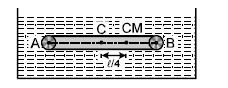
A non uniform cylinder of mass $m$ , length $l$ and radius $r$ is having its cetnre of mass at a distance $l/4$ from the centre and lying on the axis of the cylinder. The cylinder is kept in a liquid of uniform density $\rho $ . The moment of inertia of the rod about the centre of mass is $I$ . The angular acceleration of point $A$ relative to point $B$ just after the rod is released from the position shown in figure is
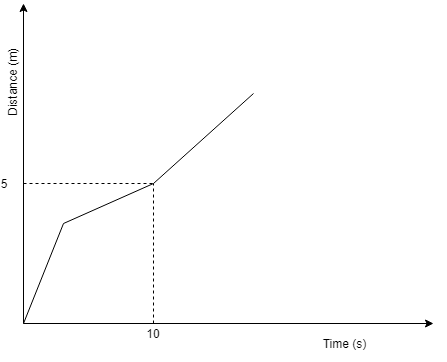
What is the velocity for a body following the graph below at $10s?$
A projectile is fired from horizontal ground with speed $v$ and projection angle $\theta$. When the acceleration due to gravity is $g$, the range of the projectile is $d$. If at the highest point in its trajectory, the projectile enters a different region where the effective acceleration due to gravity is $g^{\prime}=\frac{g}{0.81}$, then the new range is $d^{\prime}=n d$. The value of $n$ is. . . . .
A wire elongates by 1.0mm when a load W is hung from it. If this wire goes over a a pulley and two weights W each are hung at the two ends, he eloogation of he wire will be:
The dimension of Planck constant equals to that of
What is the number of degrees of freedom of an ideal diatomic molecule at ordinary temperature?
A large horizontal surface moves up and down in $S.H.M.$ with an amplitude of $1\, cm$. If a mass of $10\, kg$ (which is placed on the surface is to remain continuously in contact with it, the maximum frequency of $S.H.M.$ will be .... $Hz$
For ideal gas, which statement is not true
A monoatomic ideal gas, initially at temperature ${T_1},$ is enclosed in a cylinder fitted with a frictionless piston. The gas is allowed to expand adiabatically to a temperature. ${T_2}$ by releasing the piston suddenly. If ${L_1}$ and ${L_2}$ are the lengths of the gas column before and after expansion respectively, then ${T_1}/{T_2}$ is given by