MCQ
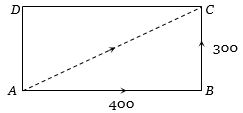
A boy walks uniformally along the sides of a rectangular park of size $400\, m × 300\, m$, starting from one corner to the other corner diagonally opposite. Which of the following statement is incorrect
  • A
    He has travelled a distance of $700\, m$
  • His displacement is $700 \,m$
  • C
    His displacement is $500\, m$
  • D
    His velocity is not uniform throughout the walk
Answer

Correct option: B.
His displacement is $700 \,m$
b
(b) Displacement $\overrightarrow {AC} = \overrightarrow {AB} + \overrightarrow {BC} $

$AC = \sqrt {{{(AB)}^2} + {{(BC)}^2}} = \sqrt {{{(400)}^2} + {{(300)}^2}} = 500m$

Distance $ = AB + BC = 400 + 300 = 700\,m$

Need a full question paper?

Generate a complete, print-ready paper with questions like this in minutes — across 16+ boards, with answer keys.

Start Generating Free

Similar questions

The musical interval between two tones of frequencies $320 Hz$ and $240 Hz$ is
A bullet of mass $10 \;g$ leaves a rifle at an initial velocity of $1000 \;m/s$ and strikes the earth at the same level with a velocity of $500\; m / s$. The work done ($Joule$) in joule overcoming the resistance of air will be
The volume of a metal sphere increases by $0.24\%$ when its temperature is raised by $40°C$. The coefficient of linear expansion of the metal is .......... $°C$
A force $\overrightarrow{ F }=(2+3 x) \hat{ i }$ acts on a particle in the $x$ direction where $F$ is in newton and $x$ is in meter. The work done by this force during a displacement from $x =0$ to $x =4\,m$, is .......$J$.
What is the path followed by a moving body, on which a constant force acts in a direction other than initial velocity (i.e. excluding parallel and antiparallel direction)?
Which of the following quantities are always positive in a simple harmonic motion?
Two bodies $A$ and $B$ collide as shown in Fig. $(i)$ and $(ii)$ Which statement is true ?
A body having its centre of mass at the origin has three of its particles at $(a, 0, 0), (0, a, 0), (0, 0, a).$ The moments of inertia of the body about the $X$ and $Y$ axes are $0.20\ \ce{kg-m^2}$ each. The moment of inertia about the $Z-$axis:
Three identical blocks of masses $m=2\; k g$ are drawn by a force $F=10.2\; N$ with an acceleration of $0.6\; ms ^{-2}$ on a frictionless surface, then what is the tension (in $N$) in the string between the blocks $B$ and $C$?
A particle moving with a uniform acceleration travels $24 \,m$ and $64\, m$ in the first two consecutive intervals of $4 \,sec$ each. Its initial velocity is............$m/sec$