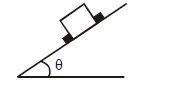
A brick of mass $2\, kg$ begins to slide down on a plane inclined at an angle of $45^° $ with the horizontal. The force of friction will be
Easy
Download our app for free and get started
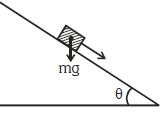
(a) For angle of repose,
Friction = Component of weight along the plane
=$mg\sin \theta $ $ = 2 \times 9.8 \times \sin {45^o}$ $ = 19.6\sin {45^o}$

Download our appand get started for free
Experience the future of education. Simply download our apps or reach out to us for more information. Let's shape the future of learning together!No signup needed.*
Similar Questions
- 1A $2 \mathrm{~kg}$ brick begins to slide over a surface which is inclined at an angle of $45^{\circ}$ with respect to horizontal axis. The co-efficient of static friction between their surfaces is:View Solution
- 2Radius of the curved road on national highway is $R$. Width of the road is $b$. The outer edge of the road is raised by $h$ with respect to inner edge so that a car with velocity $v$ can pass safe over it. The value of $h$ isView Solution
- 3A particle has initial velocity $10\,\, m/s$. It moves due to constant retarding force along the line of velocity which produces a retardation of $5\,\, m/s^2$. ThenView Solution
- 4A car of mass $1000\,kg$ negotiates a banked curve of radius $90\,m$ on a frictionless road. If banking angle is $45^o$ , the maximum speed of car is ............ $m/s$ $[g = 10\,m/s^2]$View Solution
- 5A railway line is taken round a circular arc of radius $1000\ m$, and is banked by raising the outer rail $h\ m$ above the inner rail. If the lateral force on the inner rail when a train travels round the curve at $10 \ ms^{-1}$ is equal to the lateral force on the outer rail when the train's speed is $20\ ms^{-1}$. The value of $4g\ tan\theta$ is equal to : (The distance between the rails is $1.5 \ m$).View Solution
- 6A block $A$ of mass $m_1$ rests on a horizontal table. A light string connected to it passes over a frictionless pully at the edge of table and from its other end another block $B$ of mass $m_2$ is suspended. The coefficient of kinetic friction between the block and the table is $\mu _k.$ When the block $A$ is sliding on the table, the tension in the string isView Solution
- 7A force of $750 \,N$ is applied to a block of mass $102\, kg$ to prevent it from sliding on a plane with an inclination angle $30°$ with the horizontal. If the coefficients of static friction and kinetic friction between the block and the plane are $0.4 $ and $0.3$ respectively, then the frictional force acting on the block is...... $N$View Solution
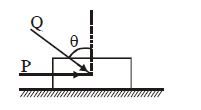
- 8A block of mass $m$ lying on a rough horizontal plane is acted upon by a horizontal force $P$ and another force $Q$ inclined an at an angle $\theta $ to the vertical. The minimum value of coefficient of friction between the block and the surface for which the block will remain in equilibrium isView Solution
- 9A plank with a box on it at one end is gradually raised about the other end. As the angle of inclination with the horizontal reaches $30^o$, the box starts to slip and slides $4.0\, m$ down the plank in $4.0\,s$. The coefficients of static and kinetic friction between the box and the plank will be, respectivelyView Solution
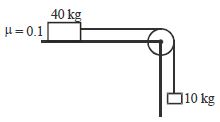
- 10For the given figure find acceleration of $40\, kg$ block ........ $m/s^2$View Solution