Question
A bucket full of water is placed in a room at $15^\circ C$ with initial relative humidity $40\%$. The volume of the room is $50m^3.$
  1. How much water will evaporate?
  2. lf the room temperature is increased by $5^\circ C, $ how much more water will evaporate? The saturation vapour pressure of water at $15^\circ C$ and $20^\circ C$ are $1.6$kPa and $2.4$kPa respectively.
Answer

  1. Rel. humidity $=\frac{\text{VP}}{\text{SVP at }15^\circ\text{C}}\Rightarrow0.4=\frac{\text{VP}}{1.6\times10^3}$
$\Rightarrow\text{VP}=0.4\times1.6\times10^3$
The evaporation occurs as along as the atmosphere does not become saturated.
Net pressure change $= 1.6 \times 10^3 - 0.4 \times 1.6 \times 10^3 = (1.6 - 0.4 \times 1.6)10^3 = 0.96 \times 10^3$
Net mass of water evaporated $=\text{m}\Rightarrow0.96\times10^3\times50=\frac{\text{m}}{18}\times8.3\times288$
$\Rightarrow\text{m}=\frac{0.96\times50\times18\times10^3}{8.3\times288}=361.45\approx361\text{g}$
  1. At $20^\circ C$ SVP $= 2.4$KPa, At $15^\circ C$ SVP $= 1.6$KPa
Net pressure charge $= (2.4 - 1.6) \times 10^3Pa = 0.8 \times 10^3Pa$
Mass of water evaporated $=\text{m}'=0.8\times10^3\ 50=\frac{\text{m}'}{18}\times8.3\times293$
$\Rightarrow\text{m}'=\frac{0.8\times50\times18\times10^3}{8.3\times293}=296.06\approx296\text{grams}$

Need a full question paper?

Generate a complete, print-ready paper with questions like this in minutes — across 16+ boards, with answer keys.

Start Generating Free

Similar questions

State Newton's third law of motion. Discuss its consequences.
A particle slides on the surface of a fixed smooth sphere starting from the topmost point. Find the angle rotated by the radius through the particle, when it leaves contact with the sphere.
The cylindrical tube of a spray pump has a cross-section of $8.0cm^2$ one end of which has $40$ fine holes each of diameter $1.0mm$. If the liquid flow inside the tube is $1.5m\ min^{–1}$​​​​​​​, what is the speed of ejection of the liquid through the holes?
A bullet fired at an angle of $30°$ with the horizontal hits the ground $3.0km$ away. By adjusting its angle of projection, can one hope to hit a target $5.0km$ away? Assume the muzzle speed to be fixed, and neglect air resistance.
The wavelength corresponding to $E_{max}$ for moon is $14$ microns. Estimate the temperature of moon. Take $b = 28.84 \times 10^{-4} mK$.
A small block of mass $200g$ is kept at the top of a frictionless incline which is $10m$ long and $3.2m$ high. How much work was required.
  1. To lift the block from the ground and put it at the top.
  2. To slide the block up the incline? What will be the speed of the block when it reaches the ground.
  3. It falls off the incline and drops vertically on the ground.
  4. It slides down the incline? Take $g = 10m/s^2$​​​​​​​.
What is the ratio between the distance travelled by the oscillator in one time period and amplitude?
Six point masses of mass m each are at the vertices of a regular hexagon of side l. Calculate the force on any of the masses.
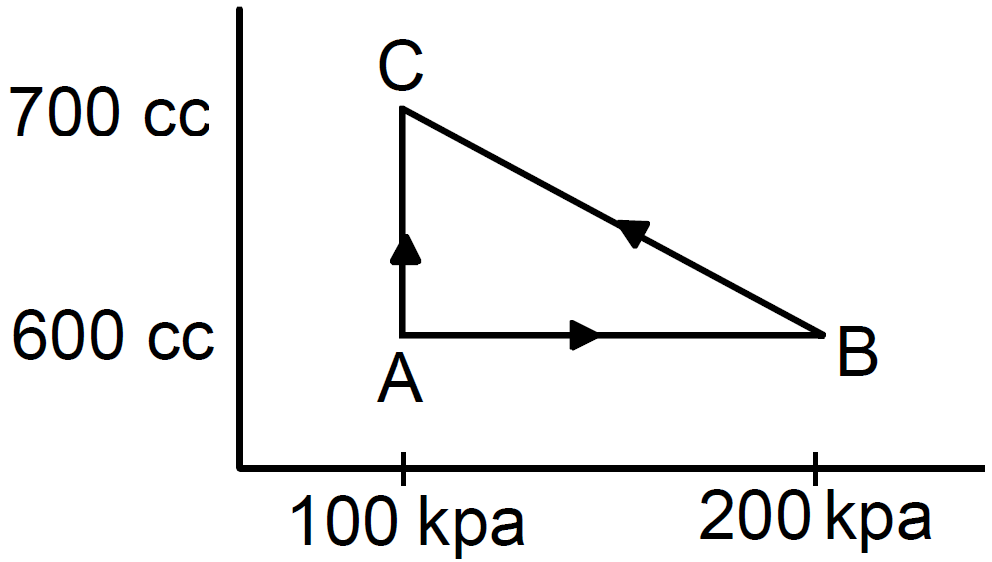
A gas is taken through a cyclic process ABCA as shown in figure. If $2.4$ cal of heat is given in the process, what is the value of J?
A rocket is fired vertically with a speed of $5 \mathrm{~km} \mathrm{~s}^{-1}$ from the earth's surface. How far from the earth does the rocket go before returning to the earth? Mass of the earth $=6.0 \times 10^{24} \mathrm{~kg}$; mean radius of the earth $=6.4 \times 10^6 \mathrm{~m}$; $\mathrm{G}=6.67$ $\times 10^{-11} \mathrm{Nm}^2 \mathrm{~kg}^{-2}$.