MCQ
A bulb and a capacitor are in series with an $ac$ source. On increasing frequency how will glow of the bulb change
  • A
    The glow decreases
  • The glow increases
  • C
    The glow remain the same
  • D
    The bulb quenches

Answer

Correct option: B.
The glow increases
b
(b) This is because, when frequency $\nu$ is increased, the capacitive reactance ${X_C} = \frac{1}{{2\pi \nu C}}$ decreases and hence the current through the bulb increases.

Need a full question paper?

Generate a complete, print-ready paper with questions like this in minutes — across 16+ boards, with answer keys.
Start Generating Free

Similar questions

In a Young's double slit experiment, the central point on the screen is
In a $L-C-R$ series $AC$ circuit, the voltage across each of the component $L, C$ and $R$ is $50\,V$ . The voltage across the $L-R$ combination will be
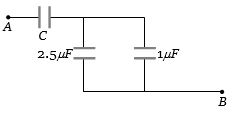
The equivalent capacitance between $A$ and $B$ in the figure is $1\,\mu F$. Then the value of capacitance $C$ is.....$\mu F$
Two cells of $e.m.f.$ $E_1$ and $E_2$ are joined in series and the balancing length of the potentiometer wire is $625$ $cm$. If the terminals of $E_1$ are reversed, the balancing length obtained is $125 \,cm$. Given $E_2 > E_1$, the ratio $E_1: E_2$ will be
The atomic number of silicon is $14$. Its ground state electron configuration is
A parallel plate capacitor of capacitance $C$ has spacing $d$ between two plates having area $A$. The region between the plates is filled with $N$ dielectric layers, parallel to its plates, each with thickness $\delta=\frac{ d }{ N }$. The dielectric constant of the $m ^{\text {th }}$ layer is $K _{ m }= K \left(1+\frac{ m }{ N }\right)$. For a very large $N \left(>10^3\right)$, the capacitance $C$ is $\alpha\left(\frac{ K \varepsilon_0 A }{ d \;ln 2}\right)$. The value of $\alpha$ will be. . . . . . . .

[ $\epsilon_0$ is the permittivity of free space]
A coil of area $80\, cm^2$ and $50\, turns$ is rotating with $2000$ revolutions per minute about an axis perpendicular to a magnetic field of $0.05\, tesla$. The maximum value of the $emf$ developed in it is
If $Q$ is the charge on the plates of a capacitor of capacitance $C, V$ the potential difference between the plates, $A$ the area of each plate and $d $ the distance between the plates, the force of attraction between the plates is
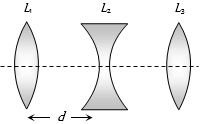
Three lenses $L_1, L_2, L_3$ are placed co-axially as shown in figure. Focal length's of lenses are given $30\, cm, 10\, cm$ and $5\, cm$ respectively. If a parallel beam of light falling on lens $L_1$, emerging $L_3$ as a convergent beam such that it converges at the focus of $L_3$. Distance between $L_1$ and $L_2$ will be......$cm$
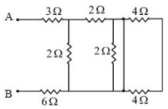
In the given circuit, the equivalent resistance between the terminal $A$ and $B$ is $........\Omega$.