Question
A bulb is made using two filaments. A switch selects whether the filaments are used individually or in parallel. When used with a 15V battery, the bulb can be operated at 5W, 10W or 15W. What should be the resistances of the filaments?

Answer

The various resistances of the bulbs $=\frac{\text{V}^2}{\text{P}}$
Resistances are $\frac{(15)^2}{10},\frac{(15)^2}{10},\frac{(15)^2}{15},=45,22.5,15.$
Since two resistances when used in parallel have resistances less than both.
The resistances are 45 and 22.5.

Need a full question paper?

Generate a complete, print-ready paper with questions like this in minutes — across 16+ boards, with answer keys.
Start Generating Free

Similar questions

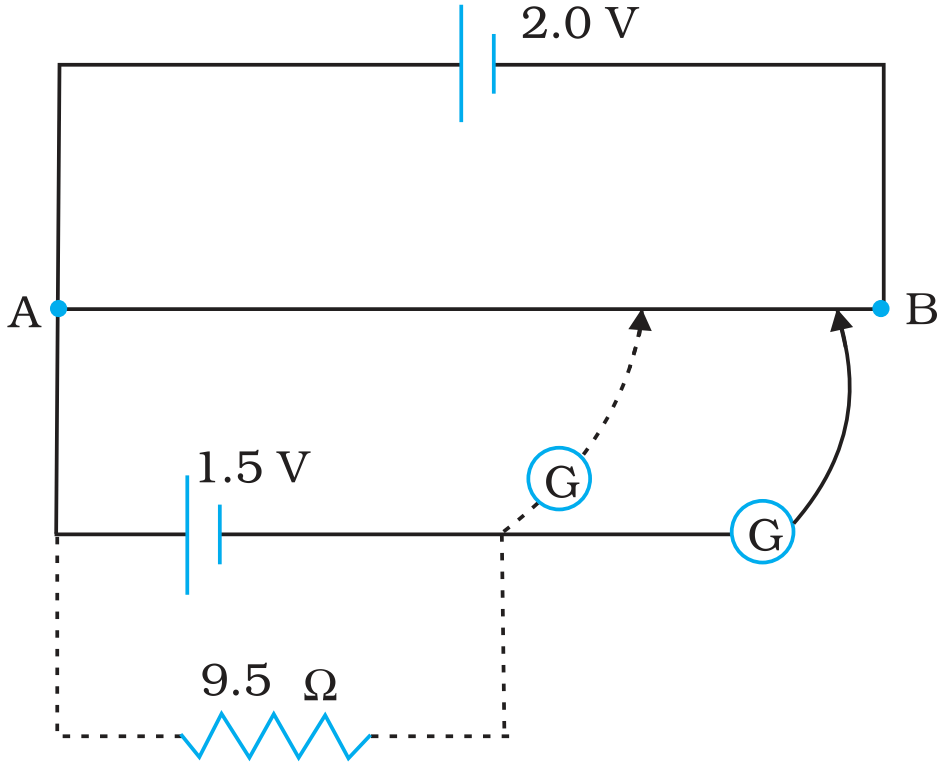
Figure shows a $2.0 V$ potentiometer used for the determination of internal resistance of a $1.5 V$ cell. The balance point of the cell in open circuit is $76.3 \ cm.$ When a resistor of $9.5\ \Omega$ is used in the external circuit of the cell, the balance point shifts to $64.8 \ cm$ length of the potentiometer wire. Determine the internal resistance of the cell.
Two spheres A and B with radii $a$ and $b$ respectively are at the same potential. What will be the ratio of surface charge densities at $A$ and $B$ ?
Define electric flux. Write its $S.I.$ unit.
$A$ charge $q$ is enclosed by a spherical surface of radius $R.$ If the radius is reduced to half, how would the electric flux through the surface change?
Define two magnetic elements of the earth.
The eyepiece of an astronomical telescope has a focal length of $10\ cm.$ The telescope is focused for normal vision of distant objects when the tube length is $1.0m.$ Find the focal length of the objective and the magnifying power of the telescope.
What is the importance of radial magnetic field in a moving coil galvanometer?
A wooden block of mass $0.5\ kg$ and density $800\ kg/m^3 $ is fastened to the free end of a vertical spring of spring constant $50N/m$ fixed at the bottom. If the entire system is completely immersed in water, find.
  1. The elongation $($or compression$)$ of the spring in equilibrium and.
  2. The time $-$ period of vertical oscillations of the block when it is slightly depressed and released.
What is the longest wavelength of photon that can ionize a hydrogen atom in its ground state? Specify the type of radiation.
The dimensions of an atom are of the order of an Angstrom. Thus there must be large electric fields between the protons and electrons. Why, then is the electrostatic field inside a conductor zero?
From what electric dipole of electric field is found and for which two cases is the result simple?