Question
A bullet hits a block kept at rest on a smooth horizontal surface and gets embedded into it. Which of the following does not change?
  1. Linear momentum of the block.
  2. Kinetic energy of the block.
  3. Gravitational potential energy of the block.
  4. Temperature of the block.

Answer

  1. Gravitational potential energy of the block.
Explanation:
When the block kept at rest is hit by a bullet, the block acquires certain velocity by the conservation of linear momentum.
Therefore, the linear momentum and the kinetic energy of the block change.
As some of the kinetic energy carried by the bullet transforms into heat energy, its temperature also changes.
However, the gravitational potential energy of the block does not change, as the height of the block does not change in this process.

Need a full question paper?

Generate a complete, print-ready paper with questions like this in minutes — across 16+ boards, with answer keys.

Start Generating Free

Similar questions

Light from a hydrogen discharge tube is incident on the cathode of a photoelectric cell, the work function of the cathode surface is 4.2 eV. In order to reduce the photocurrent to zero the voltage of the anode relative to the cathode must be made?
The mass number of a nucleus is(a) Always less than its atomic number(b) Always more than its atomic number (c) Always equal to its atomic number (d) Sometimes more than and sometimes equal to its atomic number


The limit of resolution of eye is approximately:
At the magnetic north pole of the earth, the value of the horizontal component of earth’s magnetic field and angle of dip are respectively:
A nucleus of mass 218 amu in free state decays to emit an a-particle. Kinetic energy of the a-particle emitted is 6.7 MeV. The recoil energy (in MeV) of the daughter nucleus is(a) 1.0(b) 0.5(c) 0.25(d) 0.125
       
The intensity of an electric field with E= 0 will change with distance:
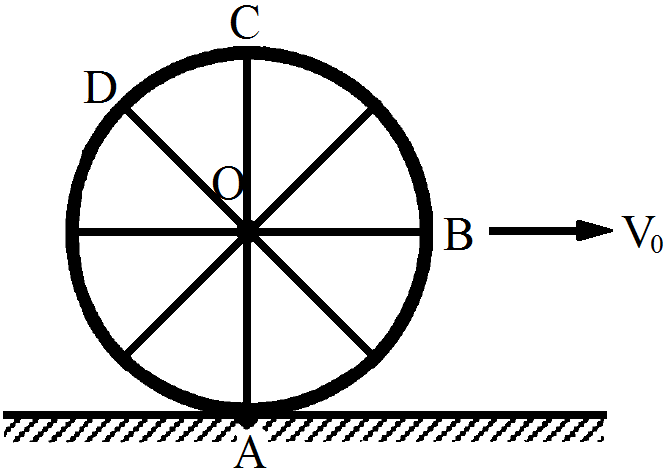
Consider a wheel of a bicycle rolling on a level road at a linear speed $v_0:$
  1. The speed of the particle $A$ is zero.
  2. The speed of $B, C$ and $D$ are all equal to $v_0.$
  3. The speed of $C$ is $2v_0.$
  4. The speed of $B$ is greater than the speed of $O.$
Which statement is correct (a) N-type germanium is negatively charged and P-type germanium is positively charged (b) Both N-type and P-type germanium are neutral(c) N-type germanium is positively charged and P-type germanium is negatively charged(d) Both N-type and P-type germanium are negatively charged


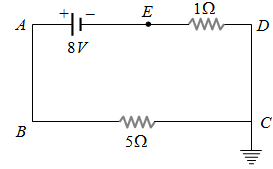
In the given circuit, the potential of the point $E$ is
A torch battery consisting of two cells of 1.45 volts and an internal resistance 0.15Ω, each cell sending currents through the filament of the lamps having resistance 1.5ohms. The value of current will be(a) 16.11 amp(b) 1.611 amp(c) 0.1611 amp(d) 2.6 amp