MCQ
A capacitor acts as an infinite resistance for.
  • $DC$
  • B
    $AC$
  • C
    $DC$ as well as $AC$
  • D
    neither $AC$ nor $DC$

Answer

Correct option: A.
$DC$

Capacitors contain at least two electrical conductors separated by a dielectric/ insulator and is used to store energy electrostatically between the conductors. It acts like an open circuit and hence acts like an infinite resistance for $DC$ currents.

Need a full question paper?

Generate a complete, print-ready paper with questions like this in minutes — across 16+ boards, with answer keys.
Start Generating Free

Similar questions

The self induction takes place when magnetic flux through a coil:
In $LC$ circuit the inductance $\mathrm{L}=40\; \mathrm{mH}$ and capacitance $\mathrm{C}=100\; \mu \mathrm{F} .$ If a voltage $\mathrm{V}(\mathrm{t})=10 \sin (314 \mathrm{t})$ is applied to the circuit, the current in the circuit is given as 
As one considers orbits with higher values of n in a hydrogen atom, the electric potential energy of the atom?
In beta decay, the typical $Q$ value is approximately:
Two cells when connected in series are balanced on $8\;m$ on a potentiometer. If the cells are connected with polarities of one of the cell is reversed, they balance on $2\,m$. The ratio of $e.m.f.$'s of the two cells is
In Young's double slit experiment, the two slits act as coherent sources of equal amplitudeAand wavelength $\lambda$ . In another experiment with the same setup the two slits are sources of equal amplitudeAand wavelength $\lambda$ but are incoherent. The ratio of the intensity of light at the midpoint of the screen in the first case to that in the second case is
In a Young’s double slit experiment, the separation of the two slits is doubled. To keep the same spacing of fringes, the distance $D $ of the screen from the slits should be made
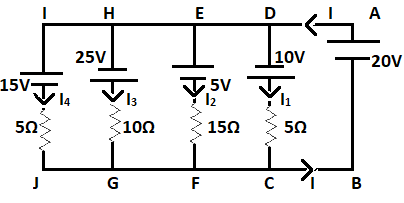
In the circuit shown below, calculate the current flowing through $20V$ cell.
Image
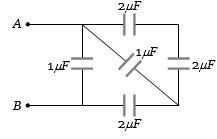
The total capacity of the system of capacitors shown in the adjoining figure between the points $A$ and $B$ is.....$\mu F$
Is the ionisation energy of an isolated free atom different from the ionisation energy Eg for the atoms in a crystalline lattice