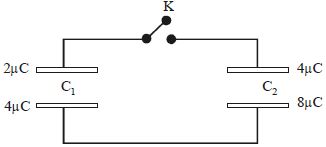
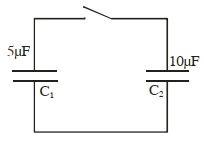
A capacitor $C _{1}$ of capacitance $5\,\mu F$ is charged to a potential of $30\,V$ using a battery. The battery is then removed and the charged capacitor is connected to an uncharged capacitor $C _{2}$ of capacitance $10\,\mu F$ as shown in figure. When the switch is closed charge flows between the capacitors. At equilibrium, the charge on the capacitor $C _{2}$ is________ $\mu C$
JEE MAIN 2022, Diffcult


Download our appand get started for free
Experience the future of education. Simply download our apps or reach out to us for more information. Let's shape the future of learning together!No signup needed.*
Similar Questions
- 1A parallel plate capacitor has capacitance $C$. If it is equally filled with parallel layers of materials of dielectric constants $K_1$ and $K_2$ its capacity becomes $C_1$. The ratio of $C_1$ to $C$ isView Solution
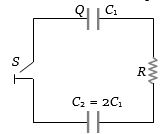
- 2Two capacitors $C_1$ and $C_2 = 2C_1$ are connected in a circuit with a switch between them as shown in the figure. Initially the switch is open and $C_1$ holds charge $Q$. The switch is closed. At steady state, the charge on each capacitor will beView Solution
- 3A force $F$ acts between sodium and chlorine ions of salt (sodium chloride) when put $1\,cm$ apart in air. The permittivity of air and dielectric constant of water are ${\varepsilon _0}$ and $K$ respectively. When a piece of salt is put in water electrical force acting between sodium and chlorine ions $1\,cm$ apart isView Solution
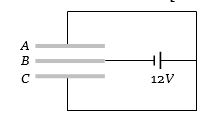
- 4Three plates $A,\;B,\;C$each of area $50\,c{m^2}$ have separation $3\,mm$ between $A$ and $B$ and $3\,mm$ between $B$ and $C$. The energy stored when the plates are fully charged isView Solution
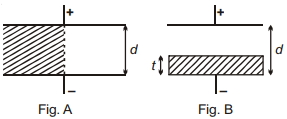
- 5A capacitor is half filled with a dielectric $(K=2)$ as shown in figure A. If the same capacitor is to be filled with same dielectric as shown, what would be the thickness of dielectric so that capacitor still has same capacity?View Solution
- 6In a uniform electric field, a cube of side $1\ cm$ is placed. The total energy stored in the cube is $8.85\mu J$ . The electric field is parallel to four of the faces of the cube. The electric flux through any one of the remaining two faces is.View Solution
- 7A particle of mass $m$ having negative charge $q$ move along an ellipse around a fixed positive charge $Q$ so that its maximum and minimum distances from fixed charge are equal to $r_1$ and $r_2$ respectively. The angular momentum $L$ of this particle isView Solution
- 8A parallel plate capacitor is charged to a potential difference of $100\,V$ and disconnected from the source of $emf$ . A slab of dielectric is then inserted between the plates. Which of the following three quantities change?View Solution
$(i)$ The potential difference
$(ii)$ The capacitance
$(iii)$ The charge on the plates
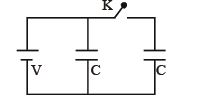
- 9Consider the arrangement shown in figure. The total energy stored is $U_1$ when key is closed. Now the key $K$ is made off (opened) and two dielectric slabs of relative permittivity ${ \in _r}$ are introduced between the plates of the two capacitors. The slab tightly fit in between the plates. The total energy stored is now $U_2$. Then the ratio of $U_1/U_2$ isView Solution
- 10Assertion : Charges are given to plates of two plane parallel plate capacitors $C_1$ and $C_2$ (such that $C_2 = 2C_1$ ) as shown in figure. Then the key $K$ is pressed to complete the circuit. Finally the net charge on upper plate and net charge the circuit. Finally the net charge on upper plate and net charge on lower plate of capacitor $C_1$ is positive.View Solution
Reason : In a parallel plate capacitor both plates always carry equal and opposite charge.