Question
A capacitor has capacitance C. Is this information sufficient to know what maximum charge the capacitor can contain? If yes, what is this charges? If no, what other information is needed?

Answer

No, This information is not sufficient. Since the charge is proportional to the potential difference across the capacitor, we need to know the potential difference applied across the capacitor.

$\text{q}\propto\text{V}$

$\Rightarrow\text{q}=\text{CV}$

Here, q is the charge, V is the potential difference applied and C is the proportionality constant, i.e. capacitance.

Need a full question paper?

Generate a complete, print-ready paper with questions like this in minutes — across 16+ boards, with answer keys.

Start Generating Free

Similar questions

The linear momentum of a car and a truck are equal. Which of the two will have greater speed?
The magnitude of linear momentum of a particle moving at a relativistic speed v is proportional to:

  1. $\text{v}$

  2. $\sqrt{1-\frac{\text{v}^2}{\text{c}^2}}$

  3. $1-\frac{\text{v}^2}{\text{c}^2}$

  4. None of these.

How much will be the internal energy change in:
  1. Isothermal process.
  2. Adiabatic process?
A metal bar of length L, area of cross-section A, Young's modulus Y and coefficient of linear expansion a, is clamped between two stout pillars. What is the force exerted by the bar when it is heated through t°C?
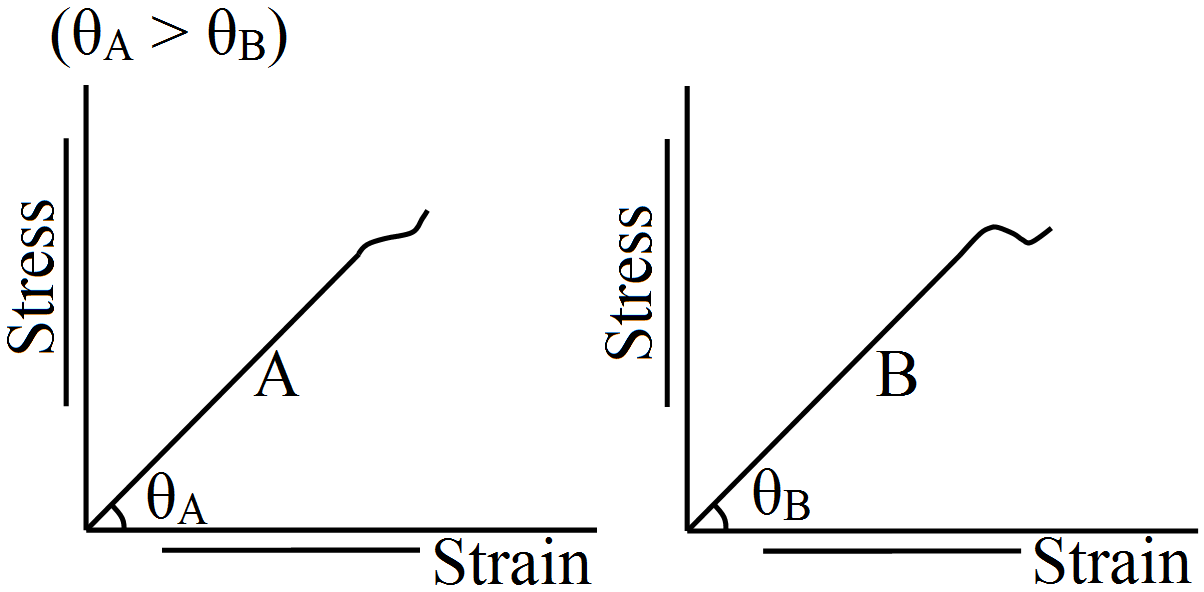
The stress-strain graph for material A and B are shown in the figure (drawn on same scale). Which of the two is stronger material? Justify your answer.

Two exactly similar simple pendula are vibrating with amplitudes 1cm and 3cm. What is the ratio of their energies of vibration?
State the number of significant figures in the following:
0.0006032m2
Show graphically the temperature variation with time associated with a cooling hot body.
Two blocks of masses 10kg and 20kg moving at speeds of 10ms-1 and 20ms-1 respectively in opposite directions, approach each other and collide. If the collision is completely inelastic, find the thermal energy developed in the process.
A body of mass 2kg initially at rest moves under the action of an applied horizontal force of 7N on a table with coefficient of kinetic friction = 0.1. Compute the:
Work done by the net force on the body in 10s.