MCQ
A capacitor having capacitance $C$ is charged to a voltage $V$. It is then removed and connected in parallel with another identical capacitor which is uncharged. The new charge on each capacitor is now
  • A
    $CV$
  • $CV / 2$
  • C
    $2 CV$
  • D
    $CV / 4$

Answer

Correct option: B.
$CV / 2$
b
(b) Charge flows to second capacitor until the potential is same i.e. $V/2$. So new charge = $CV/ 2$

Need a full question paper?

Generate a complete, print-ready paper with questions like this in minutes — across 16+ boards, with answer keys.
Start Generating Free

Similar questions

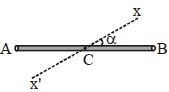
The moment of inertia of a uniform rod of length $2l$ and mass $m$ about an axis $xx'$ passing through its centre and inclined at an angle $\alpha $ is 
A thermometer graduated according to a linear scale reads a value $x_0$ when in contact with boiling water, and $x_0/3$ when in contact with ice. What is the temperature of an object in ${}^oC$, if this thermometer in the contact with the object reads $x_0/2$ ?
A cylindrical conductor has uniform cross-section. Resistivity of its material increase linearly from left end to right end. If a constant current is flowing through it and at a section distance $x$ from left end, magnitude of electric field intensity is $E$, which of the following graphs is correct
A beaker is filled with water at $4\,^oC$. At one time the temperature is increased by few degrees above $4\,^oC$ and at another time it is decreased by a few degrees below $4\,^oC$. One shall observe that:
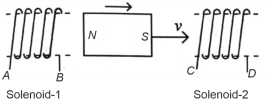
In the above diagram, a strong bar magnet is moving towards solenoid-$2$ from solenoid-$1$. The direction of induced current in solenoid-$1$ and that in solenoid-$2$, respectively, are through the directions:
Voltmeters $V_1$ and $V_2$ are connected in series across a $D.C.$ line. $V_1$ reads $80\, volts$ and has a per volt resistance of $200 \,\Omega$. $V_2$ has a total resistance of $32 \,kilo-ohms$. The line voltage is ............. 
Which of the following diagrams represents the variation of electric field vector with time for a circulatory polarized light ?
On a hot summer night, the refractive index of air is smallest near the ground and increases with height from the ground. When a light beam is directed horizontally, the Huygens' principle leads us to conclude that as it travels, the light beam
A radioactive nucleus of mass $M$ emits a photon of frequency $f$ and the nucleus recoils. The recoil energy will be
A lens made up of different material forms two images of a point object $'O'$ as shown in figure. Then