MCQ
A car goes from $A$ to $B$ (without changing direction), during first part of journey its average speed is $V_1$ and for second part of journey average speed is $V_2$ . The ratio path length of second part to the path length of first part is $\sqrt {\frac{{{V_2}}}{{{V_1}}}} $ . In that case the average speed of total path is ....... of average speeds of both parts. Choose correct option of fill. 
  • A
    Airthmatic mean
  • Geometric mean
  • C
    Harmonic mean
  • D
    Information is insufficient to answer
Answer

Correct option: B.
Geometric mean
b
$\frac{S_{2}}{S_{1}}=\sqrt{\frac{V_{2}}{V_{1}}}, \quad V_{avg}=\frac{S_{1}+S_{2}}{t_{1}+t_{2}}=\frac{S_{1}+S_{2}}{\frac{S_{1}}{V_{1}}+\frac{S_{2}}{V_{2}}}$

$=\frac{1+\frac{S_{2}}{S_{1}}}{\frac{1}{V_{1}}+\frac{1}{V_{2}} \times \frac{S_{2}}{S_{1}}}=\frac{1+\sqrt{\frac{V_{2}}{V_{1}}}}{\frac{1}{V_{1}}+\frac{1}{V_{2}} \sqrt{\frac{V_{2}}{V_{1}}}}=\sqrt{V_{2} V_{1}}$

Need a full question paper?

Generate a complete, print-ready paper with questions like this in minutes — across 16+ boards, with answer keys.

Start Generating Free

Similar questions

A non-zero external force acts on a system of particles. The velocity and the acceleration of the centre of mass are found to be $v_0$ and $a_0$ at an instant t. It is possible that:
At temperature $T,$ the $r.m.s.$ speed of helium molecules is the same as $r.m.s.$ speed of hydrogen molecules at normal temperature and pressure. The value of $T$ is  ....... $^oC$
An aeroplane moving horizontally with a speed of $180\, km/hr$. drops a food packet while flying at a height of $490\,m$. The horizontal range is........$m$
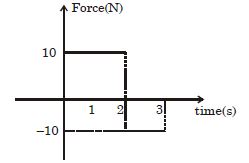
A $2\ kg$ object is floating at rest, acted upon by only force as indicated in figure. Find the total work done by the force in $3\ sec$ ..................... $\mathrm{J}$
Two identical blocks of metal are at $20^{\circ} C$ and $80^{\circ} C$, respectively. The specific heat of the material of the two blocks increases with temperature. Which of the following is true about the final temperature $T_f$ when the two blocks are brought into contact (assuming that no heat is lost to the surroundings)?
The Bernoulli's equation is given by $p +\frac{1}{2} \rho v ^{2}+ h \rho g = k$

where $p =$ pressure, $\rho =$ density, $v =$ speed, $h =$ height of the liquid column, $g=$ acceleration due to gravity and $k$ is constant. The dimensional formula for $k$ is same as that for

The diagram below shows an instantaneous position of a string as a transverse progressive wave travels along it from left to right.

Which one of the following correctly shows the direction of the velocity of the points $1, 2$ and $3$ on the string

The minimum orbital angular momentum of the electron in a hydrogen atom is:
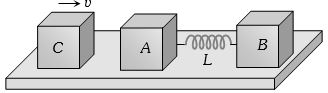
Two blocks $A$ and $B$ each of mass m are connected by a massless spring of natural length L and spring constant $K$. The blocks are initially resting on a smooth horizontal floor with the spring at its natural length as shown in figure. A third identical block $C$ also of mass $m$ moves on the floor with a speed $v$ along the line joining $A$ and $B$ and collides with $A$. Then
A gas behaves more closely as an ideal gas at: