MCQ
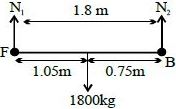
A car weighs  $1800\,\,kg$ . The distance between its front and back axles is  $1.8\,\,m$ . Its centre of gravity is $1.05\,\,m$  behind the front axle. Force exerted by the level ground on each front wheel is ........ $N.$
  • $3750$
  • B
    $7350$
  • C
    $5145$
  • D
    $10290$

Answer

Correct option: A.
$3750$
a
Taking torque about point $B$

$\mathrm{N}_{1} \times 1.8=1800 \mathrm{g} \times 0.75$

$\mathrm{N}_{1} \times 1.8=\frac{1800 \times 10 \times 0.75}{1.8}$

$\mathrm{N}_{1}=7500 \mathrm{N}$

Force exerted by ground on each front wheel

$=$$\frac{\mathrm{N}_{1}}{2}=3750 \mathrm{N}$

Need a full question paper?

Generate a complete, print-ready paper with questions like this in minutes — across 16+ boards, with answer keys.

Start Generating Free

Similar questions

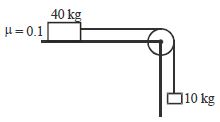
For the given figure find acceleration of $40\, kg$ block ........ $m/s^2$ 
The periodic time of a simple pendulum of length $1\, m $ and amplitude $2 \,cm $ is $5\, seconds$. If the amplitude is made $4\, cm$, its periodic time in seconds will be
A Carnot’s engine is made to work between $200°C$ and $0°C$ first and then between $0°C$ and $-200°C.$ The ratio of efficiencies of the engine in the two cases is
When a wave travels in a medium, the particle displacements are given by $y = a\, sin\, 2\pi\, (bt -cx)$ where $a, b,$ and $c$ are constants. The maximum particle velocity will be twice the wave velocity if
The latent heat of vaporization of water is $2240 \,J/gm$. If the work done in the process of vaporization of $1\, gm$ is $168\, J$, then increase in internal energy is  .... $J$
A body of mass $10\ kg$ is acted upon by two perpendicular forces, $6N$ and $8N$. The resultant acceleration of the body is:
A hollow cylinder is rolling on an inclined plane, inclined at an angle of ${30^o}$ to the horizontal. Its speed after travelling a distance of $10\ m$ will be .......... $m/s$
There is a destructive interference between the two waves of wavelength $\lambda$ coming from two different paths at a point. To get maximum sound or constructive interference at that point, the path of one wave is to be increased by
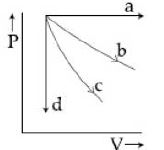
The given diagram shows four processes i.e., isochoric, isobaric, isothermal and adiabatic. The correct assignment of the processes, in the same order is given by
An aluminium rod having a length $100 \,cm$ is clamped at its middle point and set into longitudinal vibrations. Let the rod vibrate in its fundamental mode. The density of aluminium is $2600 \,kg / m ^3$ and its Young's modulus is $7.8 \times 10^{10} \,N / m ^2$. The frequency of the sound produced is .............. $Hz$