A carbon resistor has colour strips as violet, yellow brown and golden. The resistance is .............. $\Omega$
Medium


Download our appand get started for free
Experience the future of education. Simply download our apps or reach out to us for more information. Let's shape the future of learning together!No signup needed.*
Similar Questions
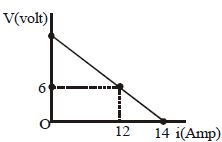
- 1$10\,Cells$, each of emf $'E'$ and internal resistance $'r'$, are connected in series to a variable external resistance. Figure shows the variation of terminal potential difference of their combination with the current drawn from the combination.$Emf$ of each cell is ............. $V$View Solution
- 2A set of $n$ equal resistors, of value $R$ each, are connected in series to a battery of emf $E$ and internal resistance $R.$ The current drawn is $I.$ Now, the $n$ resistors are connected in parallel to the same battery. Then the current drawn from battery becomes $10\,I.$ The value of $n$ isView Solution
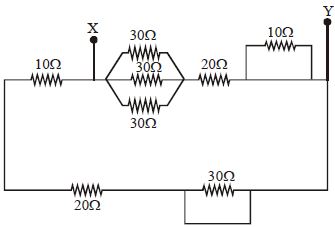
- 3Net resistance between $X$ and $Y$ is ............... $\Omega$View Solution
- 4Masses of $3$ wires of same metal are in the ratio $1 : 2 : 3$ and their lengths are in the ratio $3 : 2 : 1$. The electrical resistances are in ratioView Solution
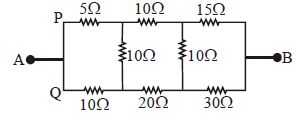
- 5In the arangement of resistances shown below, the effective resistance between points $A$ and $B$ is ............... $\Omega$View Solution
- 6An electric wire is connected across a cell of $e.m.f.$ The current $I$ is measured by an ammeter of resistance $R$. According to ohm's lawView Solution
- 7A potentiometer wire has length $4\,\, m$ and resistance $8\,\,\Omega $. The resistance that must be connected in series with the wire and an accumulator of e.m.f. $2\,\, V,$ so as to get a potential gradient $1\,\, m \,V$ per $cm$ on the wire is ............. $\Omega$View Solution
- 8The resistance of a coil is $4.2\, \Omega$ at $100\,^o C$ and the temperature coefficient of resistance of its material is $ 0.004\,^o C$. Its resistance at $0\,^o C$ is ............. $\Omega$View Solution
- 9A heating element has a resistance of $100\,\Omega $ at room temperature. When it is connected to a supply of $220\,V,$ a steady current of $2\,A$ passes in it and temperature is $500\,^oC$ more than room temperature. What is the temperature coefficient resistance of the heating element?View Solution
- 10A wire of length $100\, cm$ is connected to a cell of emf $2\,V$ and negligible internal resistance. The resistance of the wire is $3\,\Omega $. The additional resistance required to produce a potential difference of $1\, mV/cm$ is ............. $\Omega$View Solution