Question
A carnot engine absorbs 100 calories per cycle from its source at 1600K. Its efficiency is 60%. Find the temperature of the sink and work done per cycle. Given J = 4.2J/ cal.

Answer

$\text{Q}_1=100\text{cal}, \text{T}_1=1600\text{K},\ \eta=60\%=\frac35$
For glass, $\eta=1-\frac{\text{T}_2}{\text{T}_1},$
$\frac35=1-\frac{\text{T}_2}{1600}$
$\text{T}_2=640\text{K}$
As, $\eta=\frac{\text{W}}{\text{Q}_1},\text{W}=\eta\text{Q}_1$
$=\frac35\times100=60\text{cal}.$
$\text{W}=60\times4.2\text{J}$
$=252\text{J}$

Need a full question paper?

Generate a complete, print-ready paper with questions like this in minutes — across 16+ boards, with answer keys.
Start Generating Free

Similar questions

What is meant by thermal equilibrium?
Which of the following two statements is more appropriate?
  1. Two forces are added using triangle rule because force is a vector quantity.
  2. Force is a vector quantity because two forces are added using triangle rule.
The velocity of flow of water in a horizontal pipe is $10 m / sec$. Find the velocity of water at the top? $\left( g =9.8 m / s ^2\right)$
Two bodies of specific heats and C, having same heat capacities are combined to form a single composite body. What is the specific heat of the composite body?
A boy is standing on a platform which is free to rotate about its axis. The boy holds an open umbrella in his hand. The axis of the umbrella coincides with that of the platform. The moment of inertia of ''the platform plus the boy system'' is 3.0 × 10⁻³kg-m2 and that of the umbrella is 2.0 × 10³kg-m2. The boy starts spinning the umbrella about the axis at an angular speed of 2.0rev/s with respect to himself. Find the angular velocity imparted to the platform.
If displacement of a body is $\text{S}=(200\pm0.5)\text{m}$ and time taken by it is $\text{t}=(20\pm0.2)\text{s},$ then find the percentage error in the calculation of velocity.
Does it matter if one uses gauge instead of absolute pressures in applying Bernoulli’s equation? Explain.
The force with which the earth attracts an object is called the weight of the object. Calculate the weight of the moon from the following data: The universal constant of gravitation G = 6.67 × 10⁻¹¹N-m2/kg2, mass of the moon = 7.36 × 10²²kg, mass of the earth = 6 × 1024kg and the distance between the earth and the moon = 3.8 × 10⁵km.
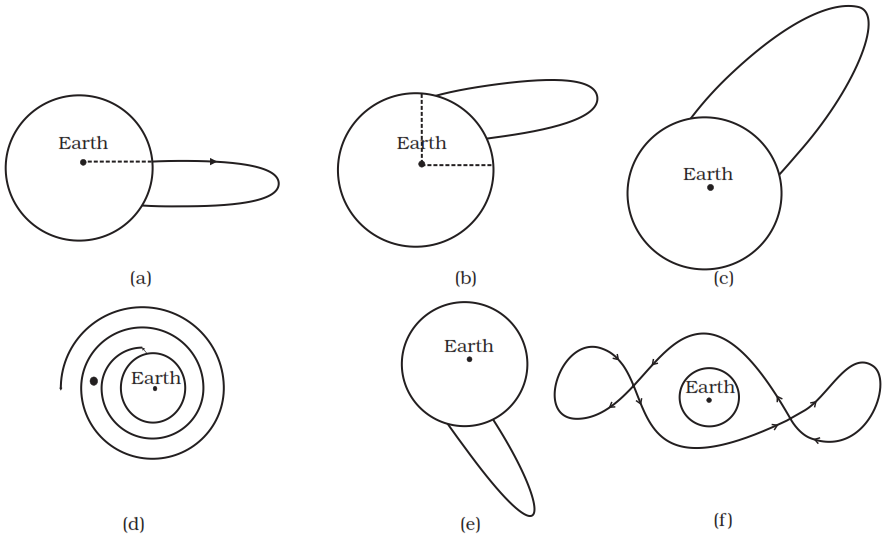
Shown are several curves. Explain with reason, which ones amongst them can be possible trajectories traced by a projectile (neglect air friction).

Define gravitational potential at a point.