MCQ
A Carnot engine has an efficiency of $50 \%$ when its source is at a temperature $327^{\circ}\,C$. The temperature of the sink is $.........^{\circ} C$
  • A
    $200$
  • $27$
  • C
    $15$
  • D
    $100$

Answer

Correct option: B.
$27$
b
Efficiency of carnot engine

$\% \eta=\left(1-\frac{T_{\text {sink }}}{T_{\text {source }}}\right) \times 100$

$T_{\text {source }}=327^{\circ}\,C =600\,K$

$50=\left(1-\frac{T_{\text {sink }}}{600}\right) \times 100$

$\frac{1}{2}=1-\frac{T_{\text {sink }}}{600}$

$T _{\text {Sink }}=300\,K$

So temp. of sink is ${ }^{\circ} C =300-2763=27^{\circ}\,C$

Need a full question paper?

Generate a complete, print-ready paper with questions like this in minutes — across 16+ boards, with answer keys.
Start Generating Free

Similar questions

A body of mass $5\; kg$ hangs from a spring and oscillates with a time period of $2\pi $ seconds. If the ball is removed, the length of the spring will decrease by
A cylindrical metallic rod in thermal contact with two reservoirs of heat at its two ends conducts an amount of heat $Q$ in time $t$. The metallic rod is melted and the material is formed into a rod of half the radius of the original rod. What is the amount of heat conducted by the new rod, when placed in thermal contact with the two reservoirs in time $t$ ?
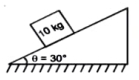
A block of mass $10 \,kg$ is kept on a fixed rough $(\mu=0.8)$ inclined plane of angle of inclination $30^{\circ}$. The frictional force acting on the block is ........... $N$
A person standing near the edge of the top of a building throws two balls A and B. The ball A is thrown vertically upward and B is thrown vertically downward with the same speed. The ball A hits the ground with a speed vA and the ball B hits the ground with a speed vB. We have:
  1. vA > vB
  2. vA < vB
  3. vA = vB
  4. The relation between vand vB depends on height of the building above the ground.
The radius of a sphere is $(5.3 \pm 0.1) \,cm$. The percentage error in its volume is
The apparent frequency of a sound wave as heard by an observer is $10\%$ more than the actual frequency. If the velocity of sound in air is $330\,m/sec$ , then

$(i)$ The source may be moving towards the observer with a velocity of $30\,ms^{-1}$

$(ii)$ The source may be moving towards the observer with a velocity of $33\,ms^{-1}$

$(iii)$ The observer may be moving towards the source with a velocity of $30\,ms^{-1}$

$(iv)$ The observer may be moving towards the source with a velocity of $33\,ms^{-1}$
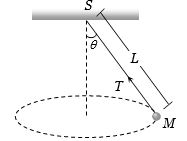
A string of length $L$ is fixed at one end and carries a mass $M$ at the other end. The string makes $2/\pi$ revolutions per second around the vertical axis through the fixed end as shown in the figure, then tension in the string is
The displacement of a body executing $SHM$ is given by $x = A \sin (2\pi t + \pi /3).$ The first time from $t = 0$ when the velocity is maximum is .... $\sec$
When the distance travelled by a body is directly proportional to the time, the body is said to have a:
A body is started from rest with acceleration 2m/ s2 till it attains the maximum velocity then retards to rest with 3m/ s2. If total time taken is 10 second then maximum speed attained is: