Question
A carnot engine operating between temperature $T_1$ and $T_2$ has efficiency $\frac{1}{6}$. When $T_2$ is lowered by $62 K$, its efficiency increases to $\frac{1}{3}$. Then find the values of $T_1$ and $T_2$.

Answer

Efficiency
$\eta=1-\frac{T_2}{T_1}$
In the first case:
$1-\frac{ T _2}{ T _1} =\frac{1}{6} \Rightarrow \frac{ T _2}{ T _1}=\frac{5}{6} $
$T _1  =\frac{6}{5} T _2$
In the second case: $1-\frac{\left(T_2-62\right)}{T_1}=\frac{1}{3} ; \frac{T_2-62}{T_1}=\frac{2}{3}$
$ \frac{ T _2-62}{\left(\frac{6}{5}\right) T _2}=\frac{2}{3}$
$T _2-62=\frac{2}{3} \times \frac{6}{5} T _2=\frac{4}{5} T _2 \Rightarrow T _2=310 K$
$T _1=\frac{6}{5} \times 310=372 K$
$T _1=372 K \text { and } T _2=310 K $

Need a full question paper?

Generate a complete, print-ready paper with questions like this in minutes — across 16+ boards, with answer keys.
Start Generating Free

Similar questions

Calculate the ratio of radii of gyration of a circular ring and a disc of the same radius with respect to the axis passing through their centers and perpendicular to their planes.
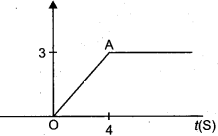
Figure shows the position-time graph of a particle of mass 4 kg. What is the
Image
(a) Force on the particle for t < 0, t > 4s, 0 < t < 4s?
(b) Impulse at t = 0 and t = 4s?
(Consider one dimensional motion only)
From a uniform disc of radius R, a circular disc of radius R / 2 is cut out. The center of the hole is at R / 2 from the center of original disc. Locate the center of gravity of the resultant flat body.
A child stands at the center of turn table with his two arms out stretched. The turn table is set rotating with an angular speed of 40 rpm. How much is the angular speed of the child if he folds his hands back and thereby reduces his moment of inertia to 2/3 times the initial value?
  1. Assume that the turn table rotates without friction
  2. Show that the child’s new kinetic energy of rotation is more than the initial kinetic energy of rotation.

How do you account for this increase in kinetic energy ?
Ajar ' $A$ ' is filled with an ideal gas characterised by parameters $P, V$ and $T$ and another jar B is filled with an ideal gas with parameters $2 P, \frac{V}{4}$ and $2 T$. Find the ratio of the number of molecules in $\operatorname{jar} A$ and $B$.
A truck of mass 1000 kg accelerates uniformly from rest to a velocity of 15 ms-1 in 5 seconds. Calculate
(i) its acceleration,
(ii) its gain in K.E.,
(iii) average power of the engine during this period, neglect friction.
For an object projected upward with a velocity $v _0$, which comes back to the same point after some time, draw
(i) Acceleration – time graph
(ii) Position – time graph
(iii) Velocity time graph
A perfect gas goes from state A to state B by absorbing $8 \times 10^5 J$ of heat and doing $6.5 \times 10^5 J$ of external work. It is now transferred between the same two states in another process in which it absorbs 10s J of heat. In second process. Find the work done in the second process.
During an experiment an ideal gas is found to obey an additional law $VP ^2=$ constant. The gas is initially at temperature $T$ and Volume $V$. Find the resulting temperature when it expands to volume $2 V$.
A flask is filled with 13g of an ideal gas at 27°C and its temperature is raised to 52°C. Find the mass of the gas that hias to be released to maintain the temperature of the gas in the flask at 52°C and the pressure is same as the initial pressure.