Question
A Carnot engine operating between two reservoirs has efficiency $\frac{1}{3}$. When the temperature of cold reservoir raised by $x$, its efficiency decreases to $\frac{1}{6}$. The value of $x$, if the temperature of hot reservoir is $99^{\circ}\,C$, will be $........\,K$
Answer

d
$T _{ H }=99^{\circ} C =99+273$

$\qquad=372\,K$

$1-\frac{ T _{ C }}{ T _{ H }}=\frac{1}{3}$

$\frac{ T _{ C }}{ T _{ H }}=\frac{2}{3} \quad(1) \Rightarrow T _{ C }=\frac{2}{3} \times 372$

$1-\frac{ T _{ C }+ X }{ T _{ H }}=\frac{1}{6}$

$\frac{5}{6}=\frac{ T _{ C }+ X }{ T _{ H }}$

$\frac{5}{6}=\frac{248+ X }{372}$

$248+ X =5 \times 62$

$X =310-248=62\,K$

Need a full question paper?

Generate a complete, print-ready paper with questions like this in minutes — across 16+ boards, with answer keys.

Start Generating Free

Similar questions

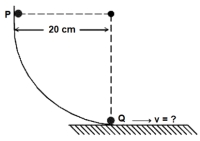
As per the given figure, a small ball $P$ slides down the quadrant of a circle and hits the other ball $Q$ of equal mass which is initially at rest. Neglecting the effect of friction and assume the collision to be elastic, the velocity of ball $Q$ after collision will be $............\,m/s$ $:\left( g =10\,m / s ^2\right)$
The speed of a transverse wave passing through a string of length $50 \;cm$ and mass $10\,g$ is $60\,ms ^{-1}$. The area of cross-section of the wire is $2.0\,mm ^{2}$ and its Young's modulus is $1.2 \times 10^{11}\,Nm ^{-2}$. The extension of the wire over its natural length due to its tension will be $x \times 10^{-5}\; m$. The value of $x$ is $...$
Experimentally it is found that $12.8\,eV$ energy is required to separate a hydrogen atom into a proton and an electron. So the orbital radius of the electron in a hydrogen atom is $\frac{9}{ x } \times 10^{-10}\,m$. The value of the $x$ is $\left(1\,eV =1.6 \times 10^{-19}\,J , \frac{1}{4 \pi \epsilon_0}=9 \times 10^9\,Nm ^2 / C ^2\right.$ and electronic charge $=1.6 \times 10^{-19}\,J\,C$ )
Two bodies of the same mass are moving with the same speed, but in different directions in a plane. They have a completely inelastic collision and move together thereafter with a final speed which is half of their initial speed. The angle between the initial velocities of the two bodies (in degree) is.
In a Young's double slit experiment, the intensities at two points, for the path difference $\frac{\lambda}{4}$ and $\frac{\lambda}{3}$ ( $\lambda$ being the wavelength of light used) are $I_1$ and $I_2$ respectively. If $I_0$ denotes the intensity produced by each one of the individual slits, then $\frac{ I _1+ I _2}{ I _0}=..............$
While working on a physics project at school physics lab, you require a $4 \,\mu F$ capacitor in a circuit across a potential difference of $1 \,kV$. Unfortunately, $4 \,\mu F$ capacitors are out of stock in your lab but $2 \,\mu F$ capacitors which can withstand a potential difference of $400 \,V$ are available in plenty. If you decide to use the $2 \,\mu F$ capacitors in place of $4 \,\mu F$ capacitor, minimum number of capacitors required are
In a photoelectric experiment a parallel beam of monochromatic light with power of $200 W$ is incident on a perfectly absorbing cathode of work function $6.25 eV$. The frequency of light is just above the threshold frequency so that the photoelectrons are emitted with negligible kinetic energy. Assume that the photoelectron emission efficiency is $100 \%$. A potential difference of $500 V$ is applied between the cathode and the anode. All the emitted electrons are incident normally on the anode and are absorbed. The anode experiences a force $F = n \times 10^{-4} N$ due to the impact of the electrons. The value of $n$ is. . . . .

Mass of the electron $m _{ c }=9 \times 10^{-31} kg$ and $1.0 eV =1.6 \times 10^{-19} J$.

A nuclear fuel rod generates energy at a rate of $5 \times 10^8 \,W / m ^3$. It is in the shape of a cylinder of radius $4.0 \,mm$ and length $0.20 \,m$. A coolant of specific heat $4 \times 10^3 \,Jkg ^{-1} K ^{-1}$ flows past it at a rate of $0.2 \,kgs ^{-1}$. The temperature rise in this coolant is approximately ............ $^{\circ} C$
A prism of refractive index $\sqrt 2 $ has refracting angle $60^o$. In order that a ray suffers minimum deviation it should be incident at an angle.......$^o$
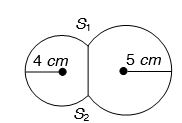
Two soap bubbles of radii ${r_1}$ and ${r_2}$ equal to $4 \,cm $ and $5 \,cm $ are touching each other over a common surface ${S_1}{S_2}$ (shown in figure). Its radius will be ....... $cm$