Question
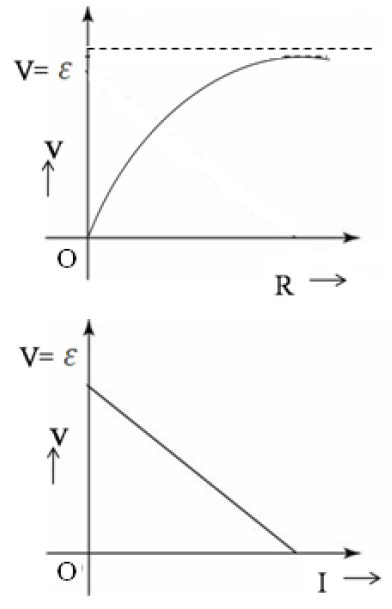
A cell of emf 'E' and internal resistance 'r' is connected across a variable load resistor R. Draw the plots of the terminal voltage V versus (i) R and (ii) the current I.
It is found that when R = 4$\Omega$, the current is 1 A and when R is increased to 9$\Omega$, the current reduces to 0.5 A. Find the values of the emf E and internal resistance r.
Answer


$\text{I} = \frac{\text{E}}{\text{R} +\text{r}}$

$1 = \frac{\text{E}}{4 + \text{r}}$

$ = >\text{E} = 4 +\text{r}$ ..... (i)

Also,

$0.5 =\frac{\text{E}}{9+ \text{r}}$

E = 4.5+ 0.5 r ..... (ii)

From equation (i) & (ii)

4 + r = 4.5 + 0.5

$\therefore\text{r} = 1\Omega$

Using this value of r, we get.

E = 5V.

Need a full question paper?

Generate a complete, print-ready paper with questions like this in minutes — across 16+ boards, with answer keys.

Start Generating Free

Similar questions

The voltage and current in a series AC circuit are given by, $\text{V}=\text{V}_0\cos\omega\text{t}$ and $\text{i}=\text{i}_0\sin\omega\text{t}.$ What is the power dissipated in the circuit?
A short bar magnet of magnetic moment m =$=0.32 JT ^{-1}$ is placed in a uniform magnetic field of 0.15 T. If the bar is free to rotate in the plane of the field, which orientation would correspond to its (a) stable equilibrium and (b) unstable equilibrium? What is the potential energy of the magnet in each case?
  1. Write the functions of the three segments of a transistor.
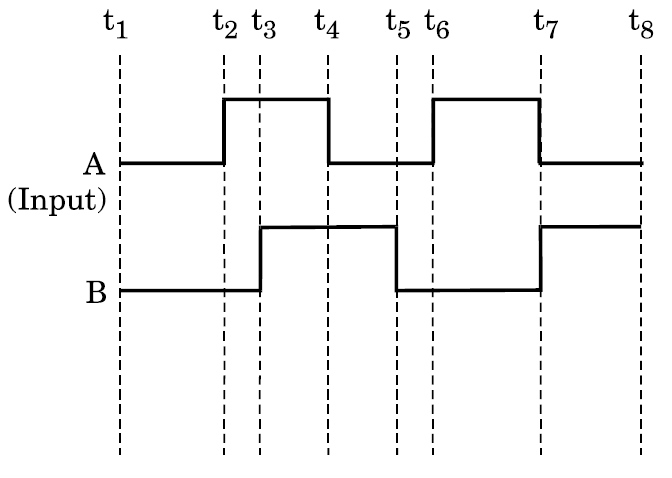
  2. The figure shows the input waveforms A and B for ‘AND’ gate. Draw the output waveform and write the truth table for this logic gate.

A swimmer wishes to cross a 500m wide river flowing at 5km/h. His speed with respect to water is 3km/h.
  1. If he heads in a direction making an angle 0 with the flow, find the time he takes to cross the river.
  2. Find the shortest possible time to cross the river.
A transverse wave of amplitude 0.50mm and frequency 100Hz is produced on a wire stretched to a tension of 100N. If the wave speed is 100m/s, what average power is the source transmitting to the wire?
In a common emitter mode of a transistor, the d.c. current gain is 20, the emitter current is 7mA. Calculate (i) base current and (ii) collector current.
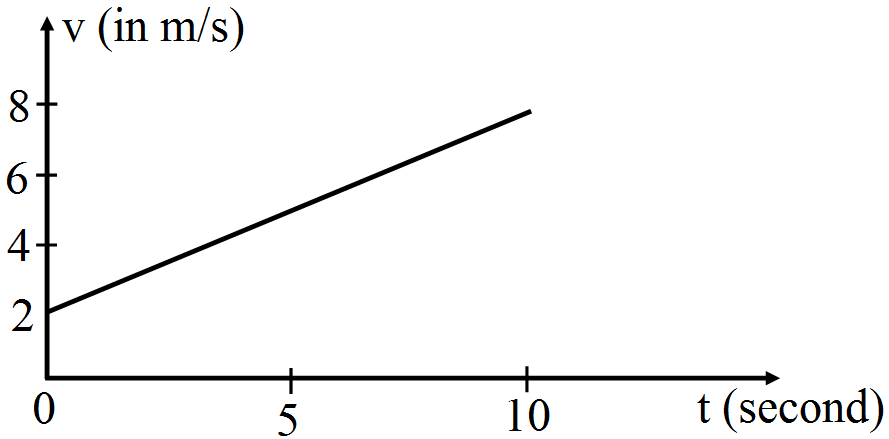
Figure shows the graph of velocity versus time for a particle going along the X-axis. Find:
  1. The acceleration.
  2. The distance travelled in 0 to 10s.
  3. The displacement in 0 to 10s.

A 100W light bulb is placed at the centre of a spherical chamber of radius 20cm. Assume that 60% of the energy supplied to the bulb is converted into light and that the surface of the chamber is perfectly absorbing. Find the pressure exerted by the light on the surface of the chamber.
With the help of a circuit diagram, explain the working of a junction diode as a full wave rectifier. Draw its input and output waveforms. Which characteristic property makes the junction diode suitable for rectification?
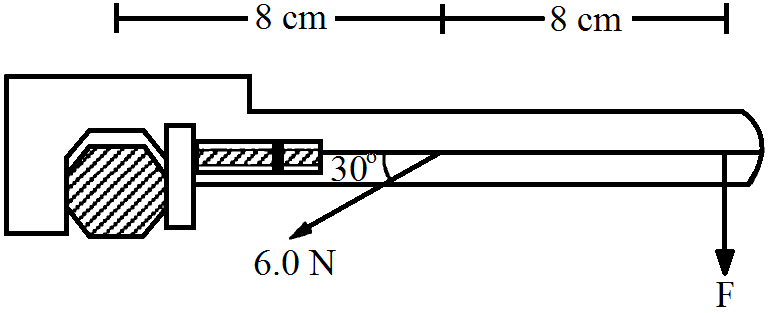
When a force of 6.0N is exerted at 30° to a wrench at a distance of 8cm from the nut, it is just able to loosen the nut. What force F would be sufficient to loosen it if it acts perpendicularly to the wrench at 16cm from the nut?