A cell of e.m.f. $E$ is connected with an external resistance $R$, then p.d. across cell is $V$. The internal resistance of cell will be
Medium


Download our appand get started for free
Experience the future of education. Simply download our apps or reach out to us for more information. Let's shape the future of learning together!No signup needed.*
Similar Questions
- 1The current flowing through a conductor connected across a source is $2\,A$ and $1.2\,A$ at $0^{\circ}\,C$ and $100^{\circ}\,C$ respectively. The current flowing through the conductor at $50^{\circ}\,C$ will be $......\times 10^2\,mA$.View Solution
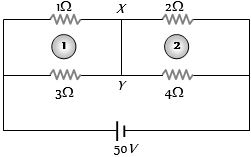
- 2Current through wire $XY$ of circuit shown is ................ $A$View Solution
- 3A storage battery has $e.m.f.$ $15\, volts$ and internal resistance $0.05\, ohm$. Its terminal voltage when it is delivering $10\, ampere$ is ............... $volts$View Solution
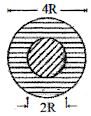
- 4A wire of circular cross section has inner portion of radius $R$ made of material of resisitivity $\rho$ and is surrounded by an outer portion of thickness $R$ made of a material of double resisitivity. Find the resistance of length $l$ of such wireView Solution
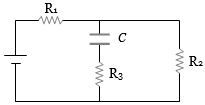
- 5In the circuit here, the steady state voltage across capacitor $C$ is a fraction of the battery $e.m.f.$ The fraction is decided byView Solution
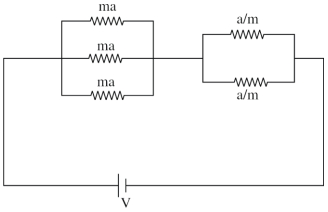
- 6In the given circuit ' $a$ ' is an arbitrary constant. The value of $m$ for which the equivalent circuit resistance is minimum, will be $\sqrt{\frac{ x }{2}}$. The value of $x$ is ...........View Solution
- 7A wire has resistance $12\,\Omega $. It is bent in the form of a circle. The effective resistance between the two points on any diameter is equal to ................ $\Omega$View Solution
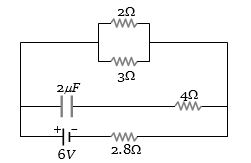
- 8In the figure shown, the capacity of the condenser $C$ is $2\,\mu F$. The current in $2\,\Omega $ resistor is ............... $A$View Solution
- 9In the box shown current $i$ enters at $H$ and leaves at $C$. If $i_{AB} = \frac{{\text{i}}}{6}$ , $i_{DC} = \frac{{\text{2i}}}{3}$ ,$i_{HA} = \frac{{\text{i}}}{2} , i_{GF} = \frac{{\text{i}}}{6} , i_{HE} = \frac{{\text{i}}}{6}$ , choose the branch in which current is zeroView Solution

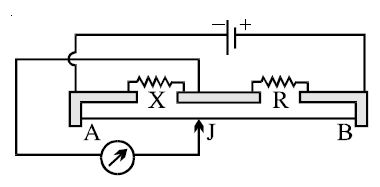
- 10The figure shows a meter-bridge circuit, with $AB = 100\, cm$,$ X = 12\,\Omega$ and $R = 18\,\Omega$ , and the jockey $J$ in the position of balance. If $R$ is now made $8\,\Omega$ , through what distance will $J$ have to be moved to obtain balance? .............. $cm$View Solution