Question
A certain element emits $\text{K}_\alpha$ X-ray of energy 3.69keV. Use the data from the previous problem to identify the element.

Answer

$\text{E}=3.69\text{Kev}=3690\text{eV}$
$\lambda=\frac{\text{hc}}{\text{E}}=\frac{1242}{3690}=0.33658\text{nm}$
$\sqrt{\frac{\text{C}}{\lambda}}\text{a}(\text{z}-\text{b})$
$\text{a}=5\times10^7\sqrt{\text{Hz}}$
$\text{b}=1.37$ (from previous problem)
$\sqrt{\frac{3\times10^8}{0.34\times10^{-9}}}$
$=5\times10^7(\text{Z}-1.37)$
$\Rightarrow\sqrt8.82\times10^{-17}=5\times10^7({\text{Z}-1.37)}$
$\Rightarrow9.39\times10^8=5\times10^7(\text{Z}-1.37)$
$\Rightarrow\frac{93.9}{5}=\text{Z}-1.37$
$\Rightarrow\text{Z}=20.15=20$
$\therefore$ The element is calcium.

Need a full question paper?

Generate a complete, print-ready paper with questions like this in minutes — across 16+ boards, with answer keys.
Start Generating Free

Similar questions

How many is energy states are present in one mole of sodium vapour? Are they all filled in normal conditions? "How many 3s energy states are present in one mole of sodium vapour? Are they all filled in normal conditions?
An emf $\varepsilon=100 \sin 314 t$ is applied across a pure capacitor of $637 \mu F$. Find
$i.$ the instantaneous current $I$
$ii.$ instantaneous power $P$
$ii.$ the frequency of power and
$iii.$ the frequency of power and
$iv.$ the maximum energy stored in the capacitor.
Are the nucleons fundamental particles, or do they consist of still smaller parts? One way to find out is to probe a nucleon just as Rutherford probed an atom. What should be the kinetic energy of an electron for it to be able to probe a nucleon? Assume the diameter of a nucleon to be approximately $10^{-15}m.$
A calorimeter of negligible heat capacity contains 100cc of water at 40°C. The water cools to 35°C in 5 minutes. The water is now replaced by K-oil of equal volume at 40°C. Find the time taken for the temperature to become 35°C under similar conditions. Specific heat capacities of water and K-oil are $4200Jkg^{-1}K^{-1}$ and $2100Jkg^{-1}K^{-1}$ respectively. Density of K-oil $= 800kgm^3.$
A particle is subjected to two simple harmonic motions given by $\text{x}_1=2.0\sin(100\pi\text{t})$ and $\text{x}_2=2.0\sin\Big(120\pi\text{t}+\frac{\pi}{3}\Big)$ where x is in centimeter and t in second. Find the displacement of the particle at
  1. t = 0.0125.
  2. t = 0.025.
A small source of sound oscillates in simple harmonic motion with an amplitude of 1.7cm. A detector is placed along the line of motion of the source. The source emits a sound of frequency 800Hz which travels at a speed of 340m/s. If the width of the frequency band detected by the detector is 8Hz, find the time period of the source.
One end of a 10cm long silk thread is fixed to a large vertical surface of a charged nonconducting plate and the other end is fastened to a small ball having a mass of 10g and a charge of $4.0 \times 10^{-5}C$. In equilibrium, the thread makes an angle of 60° with the vertical. Find the surface charge density on the plate.
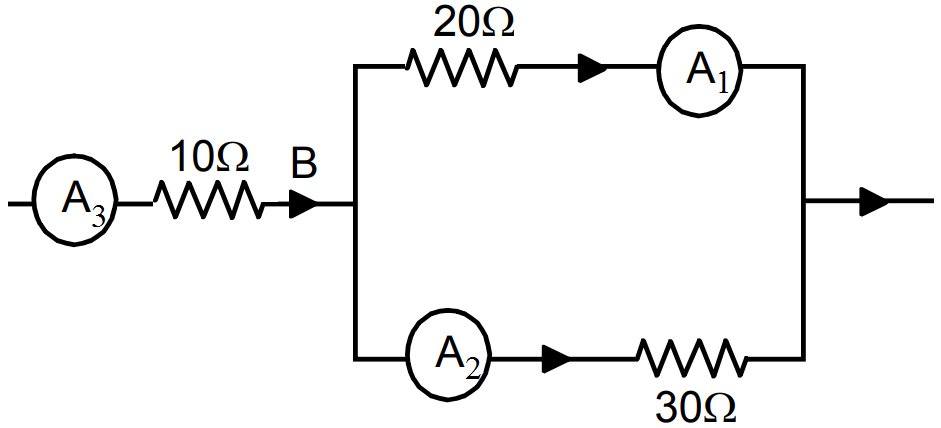
If the reading of the ammeter, $A_1$ in the figure. is $2.4A$, what will be the readings of ammeters $A_2$ and $A_3?$ Neglect the resistances of the ammeters.
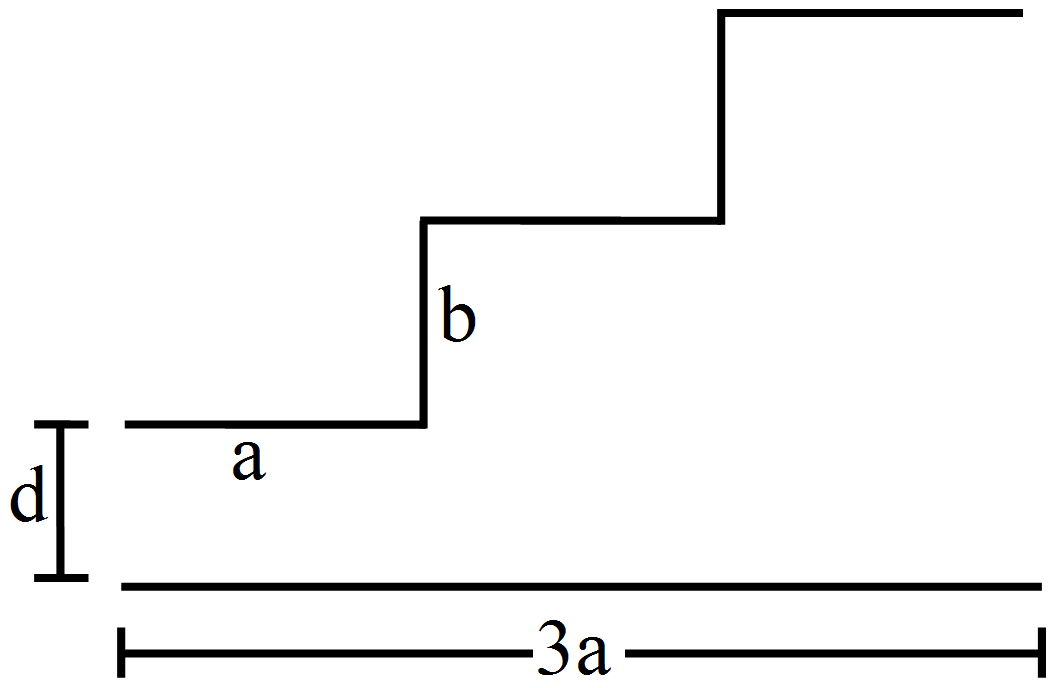
A capacitor is made of a flat plate of area A and a second plate having a stair-like structure as shown in figure. The width of each stair is a and the height is b. Find the capacitance of the assembly.
A 250g block slides on a rough horizontal table. Find the work done by the frictional force in bringing the block to rest if it is initially moving at a speed of 40cm/s. If the friction coefficient between the table and the block is 0.1, how far does the block move before coming to rest?