Question
A charge Q is uniformly distributed on a thin spherical shell. What is the field at the centre of the shell? If a point charge is brought close to the shell, will the field at the centre change? Does your answer depend on whether the shell is conducting or nonconducting?

Answer

The field at the centre of the shell is zero. As all the charge given to a conductor resides on the surface, the field at any point inside the conducting sphere is zero. Also, the charge distribution at the surface is uniform so, all the electric field vectors due to these charges at the centre are equal and opposite. So, they cancel each other, resulting in a zero net value of the field.
When a charge is brought near the shell, due to induction, opposite polarity charges induce on the surface nearer to the charge and the same polarity charges appear on the face farther from the charge. In this way, a field is generated inside the shell. Hence, the field at the centre is non-zero.
Yes, our answer changes in case of a non-conducting spherical shell. As the charge given to the surface of a non-conducting spherical shell spreads non-uniformly, there is a net electric field at the centre of the sphere.
Need a full question paper?

Generate a complete, print-ready paper with questions like this in minutes — across 16+ boards, with answer keys.

Start Generating Free

Similar questions

State and explain Newton's law of cooling. Calculate the increase in the temperature of water which falls from a height of $100m$. Assume that $90\%$ of the energy due to fall is converted into heat and is retained by water. $J = 4.2J/ Cal^{-1}$.
A body weighs 63N on the surface of the earth. What is the gravitational force on it due to the earth at a height equal to half the radius of the earth?
An inductor of inductance 2.00H is joined in series with a resistor of resistance $200\Omega$ and a battery of emf 2.00V. At t = 10ms, find
  1. The current in the circuit.
  2. The power delivered by the battery.
  3. The power dissipated in heating the resistor.
  4. The rate at which energy is being stored in magnetic field.
A lead bullet strikes against a steel armour plate with the velocity of $300ms^{-1}$. If the bullet falls dead after the impact, find the rise in temperature of the bullet, assuming that the heat produced is shared equally between the bullet and the target. Specific heat of lead = $0.03cal/g^{-1}\circ C^{-1}$.
A ball is thrown vertically upwards with a velocity of $20 m s ^{-1}$ from the top of a multistorey building. The height of the point from where the ball is thrown is $25.0 m$ from the ground. (a) How high will the ball rlse? and (b) how long will it be before the ball hits the ground? Take $g =10 m s ^{-2}$.
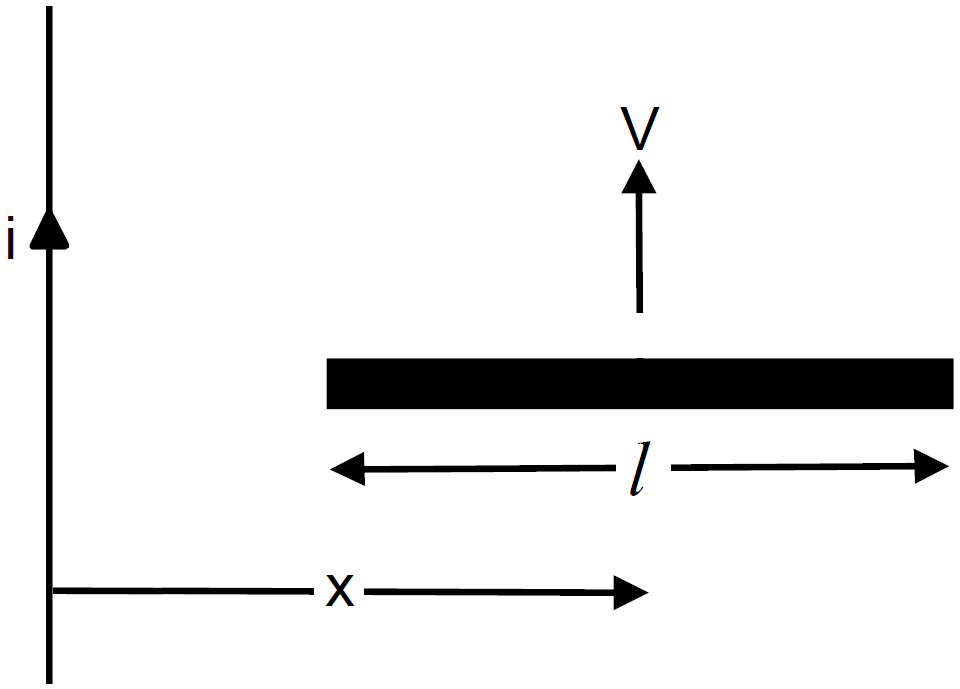
Figure shows a straight, long wire carrying a current i and a rod of length l coplanar with the wire and perpendicular to it. The rod moves with a constant velocity v in a direction parallel to the wire. The distance of the wire from the centre of the rod is x. Find motional emf induced in the rod.
A mild steel wire of length $1.0m$ and cross-sectional area $0.50 \times 10^{-2}cm^2$ is stretched, well within its elastic limit, horizontally between two pillars. A mass of $100g$ is suspended from the mid-point of the wire. Calculate the depression at the midpoint.
In an experiment with Foucault's apparatus, the various distances used are as follows:
Distance between the rotating and the fixed mirror = 16m
Distance between the lens and the rotating mirror = 6m
Distance between the source and the lens = 2m
When the mirror is rotated at a speed of 356 revolutions per second, the image shifts by 0.7mm. Calculate the speed of light from these data.
Bullets are fired at regular intervals of 10 seconds from an armoured car. A is moving with a speed of 30m/s towards B. At what interval will an officer seated in car B and dashing with a speed of 60m/s towards A hear the report? Velocity of sound = 330m/s.
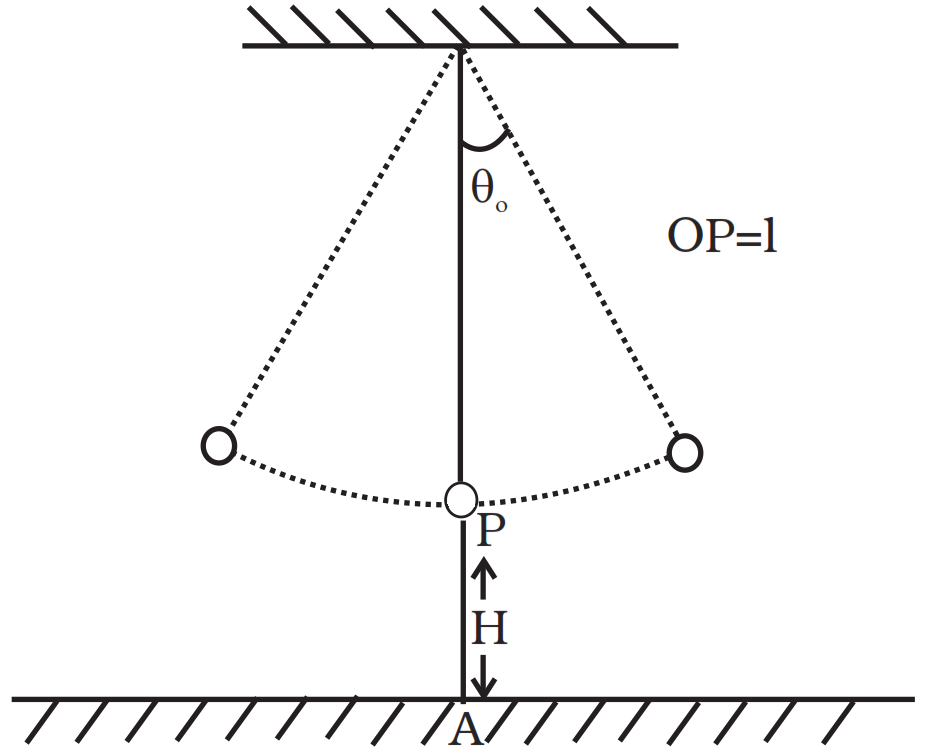
A simple pendulum of time period $1s$ and length l is hung from a fixed support at O, such that the bob is at adistance H vertically above A on the ground The amplitude is $\theta$ The string snaps at $\theta=\frac{\theta_0}{2}$ Find the time taken by the bob to hit the ground. Also find distance from A where bob hits the ground. Assume θ to be small so that $\sin\theta_0\ \text{and}\ \cos\theta_0=1.$