MCQ
A charged conducting sphere does not produce an electric field:
- ✓at some interior point
- Bat some external point
- Cat a distance of more than 2 meters
- Dat a distance of more than 10 meters
Generate a complete, print-ready paper with questions like this in minutes — across 16+ boards, with answer keys.
In the given circuit, with steady current, the potential drop across the capacitor must be
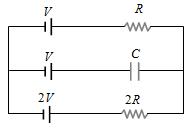
|
(a) V |
(b) V / 2 |
(c) V / 3 |
(d) 2V / 3 |
The length of the compound microscope is 14 cm. The magnifying power for relaxed eye is 25. If the focal length of eye lens is 5 cm, then the object distance for objective lens will be
|
(a) 1.8 cm |
(b) 1.5 cm |
(c) 2.1 cm |
(d) 2.4 cm |
Cathode rays are
|
(a) Positive rays |
(b) Neutral rays |
(c) He rays |
(d) Electron waves |
The minimum intensity of light to be detected by human eye is  . The number of photons of wavelength 5.6
  entering the eye, with pupil area
  , per second for vision will be nearly
|
(a) 100 |
(b) 200 |
(c) 300 |
(d) 400 |
A moving coil galvanometer has N number of turns in a coil of effective area A, it carries a current I. The magnetic field B is radial. The torque acting on the coil is
|
(a) |
(b) |
(c) |
(d) NABI |
In a fission process, nucleus A divides into two nuclei B and C, their binding energies being  and
and  respectively. Then
|
(a) |
(b) |
(c) |
(d) |


