MCQ
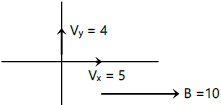
A charged particle moves in a magnetic field $\vec B = 10\,\hat i$ with initial velocity $\vec u = 5\hat i + 4\hat j$ The path of the  particle will be
  • A
    straight line
  • B
    circle
  • helical
  • D
    none

Answer

Correct option: C.
helical
c
$Y-component$ of velocity will make the particle to move in circle whereas $x$ $-component$ of velocity will make particle move along $x$$-axis.$ So motion is helical.

Need a full question paper?

Generate a complete, print-ready paper with questions like this in minutes — across 16+ boards, with answer keys.
Start Generating Free

Similar questions

The typical ionisation energy of a donor in silicon is.....$eV$
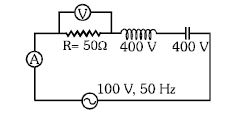
In given $LCR$ circuit, the voltage across the terminals of a resistance and current will be
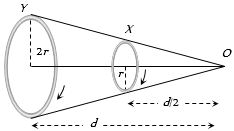
Two circular coils $X$ and $Y$, having equal number of turns, carry equal currents in the same sense and subtend same solid angle at point $O$. If the smaller coil, $X$ is midway between $O$ and $Y$, then if we represent the magnetic induction due to bigger coil $Y$ at $O$ as $BY$ and that due to smaller coil $X$ at $O$ as $BX$ , then
The elongation of a wire on the surface of the earth is $10^{-4} \; m$. The same wire of same dimensions is elongated by $6 \times 10^{-5} \; m$ on another planet. The acceleration due to gravity on the planet will be $\dots \; ms ^{-2}$. (Take acceleration due to gravity on the surface of earth $=10 \; m / s ^{-2}$ )
An electron of mass $m$ when accelerated through a potential difference $V$ has de-Broglie wavelength $\lambda $. The de-Broglie wavelength associated with a proton of mass $M$ accelerated through the same potential difference will be
Statement $I :$Two forces $(\overrightarrow{{P}}+\overrightarrow{{Q}})$ and $(\overrightarrow{{P}}-\overrightarrow{{Q}})$ where $\overrightarrow{{P}} \perp \overrightarrow{{Q}}$, when act at an angle $\theta_{1}$ to each other, the magnitude of their resultant is $\sqrt{3\left({P}^{2}+{Q}^{2}\right)}$, when they act at an angle $\theta_{2}$, the magnitude of their resultant becomes $\sqrt{2\left({P}^{2}+{Q}^{2}\right)}$. This is possible only when $\theta_{1}<\theta_{2}$.

Statement $II :$ In the situation given above. $\theta_{1}=60^{\circ} \text { and } \theta_{2}=90^{\circ}$ In the light of the above statements, choose the most appropriate answer from the options given below

The power radiated from a linear antenna of length $l$ is proportional to

(Given, $\lambda=$ Wavelength of wave):
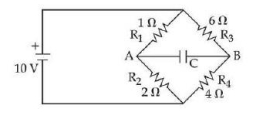
The charge accumulated on the capacitor connected in the following circuit is________ $\mu \mathrm{C}$ (Given $\mathrm{C}=150\  \mu \mathrm{F}$ )
A man runs towards a mirror at a speed $15 \,m/s $ The speed of the image relative to the mirror is......$m{s^{ - 1}}$
Ketones $(R - \mathop C\limits_{\mathop {||}\limits_O } - {R_1})$ where $R = {R_1} = $ alkyl group. It can be obtained in one step by