MCQ
A chemical reaction cannot occur at all if
  • $\Delta H$ value is positive and $\Delta S$ value is negative
  • B
    $\Delta H$ value is negative and $\Delta S$ value is positive
  • C
    $\Delta H$ and $\Delta S$ values are negative but $\Delta H\,>\,T\Delta S$
  • D
    $\Delta H$ and $\Delta S$ values are positive but $\Delta H\,>\,T\Delta S$
Answer

Correct option: A.
$\Delta H$ value is positive and $\Delta S$ value is negative
a

Need a full question paper?

Generate a complete, print-ready paper with questions like this in minutes — across 16+ boards, with answer keys.

Start Generating Free

Similar questions

The solubility product for a salt of the type $AB$ is $4 \times 10^{-8}$. What is the molarity of its standard solution?
One mole of $O_{2(g)}$ and two moles of $SO_{2(g)}$ were heated in a closed vessel of one-litre capacity at $1098\, K$. At equilibrium $1.6\, moles$ of $SO_{3(g)}$ were found. The equilibrium constant $K_c$ of the reaction would be
When oxalic acid reacts with cone. $H_2SO_4,$ two gases produced are of neutral and acidic in nature respectively. Potassium hydroxide absorbs one of the two gases. The product formed during this absorption and the gas which gets absorbed are respectively
Watermelon model of atom was proposed by :
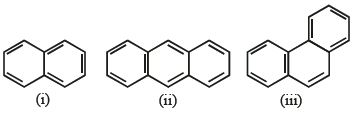
Identify the polynuclear aromatic compound which is aromatic
Calculate the enthalpy change on freezing of 1.0 mol of water at $10.0^{\circ} C$ to the ice at $-10.0^{\circ} C . \Delta_{\text {fus }} H =6.03 kJ$ $\operatorname{mol}^{-1}$ at $0^{\circ} C$.
a. $C _{ P }\left[ H _2 O ( l )\right]=75.3 Jmol ^{-1} K^{-1}$
b. $C _{ P }\left[ H _2 O ( s )\right]=36.8 Jmol ^{-1} K^{-1}$
Which of the following is a buffer solution ?
Assign true $(T)$ and false $(F)$ for following statements and select correct option for your answer

$(a)\, IP$ of $O_{(g)}$ is less than $IP$ of $O_{(g)}^ - $
$(b)\, IP$ of $Ne_{(g)}$ is greater than $IP$ of $Ne_{(g)}^ + $
$(c)\, EA$ of $O_{(g)}^ + $ is greater than $EA$ of $O_{(g)}$
$(d)\, IP$ of $N_{(g)}$ is greater than $IP$ of $N_{(g)}^ + $

The species having pyramidal shape is
Combustion of glucose takes place according to the equation, ${C_6}{H_{12}}{O_6} + 6{O_2} \to 6C{O_2} + 6{H_2}O$,$\Delta H = - 72\,kcal$. How much energy will be required for the production of $1.6 \,g$  of glucose......$kcal$. (Molecular mass of glucose $= 180 \,g$)