MCQ
A chemical reaction is at equilibrium when
  • A
    Reactants are completely transformed into products
  • The rates of forward and backward reactions are equal
  • C
    Formation of products is minimised
  • D
    Equal amounts of reactants and products are present

Answer

Correct option: B.
The rates of forward and backward reactions are equal
b
If the rate of forward reaction equals rate of backward reaction, then the reaction is said to be in equilibrium. At this stage, there is no further change in the concentrations of reactants as well as products.

Need a full question paper?

Generate a complete, print-ready paper with questions like this in minutes — across 16+ boards, with answer keys.

Start Generating Free

Similar questions

For the reaction

$Sn{O_2}(s) + 2{H_2}\left( g \right) \rightleftharpoons 2{H_2}O\left( g \right) + Sn\left( l \right)$

At equilibrium, the mixture of steam and hydrogen contains $40\%$ $H_2$ by volume then find $K_p$ for the reaction
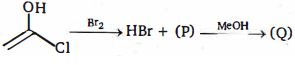
Product $(Q)$ is
Which are the correct IUPAC names of the following compound?
$\ \ \ \ \ \ \ \ \ \ \ \ \ \ \ \ \ \ \ \ \ \ \ \ \ \ \ \ \ \ \ \ \ \ \ \text{HC(CH}_3)_2\\\ \ \ \ \ \ \ \ \ \ \ \ \ \ \ \ \ \ \ \ \ \ \ \ \ \ \ \ \ \ \ \ \ \ \ \ \ \ \ |\\\text{H}_3\text{C}-\text{CH}_2-\text{CH}_2-\text{CH}-\text{CH}-\text{CH}_2-\text{CH}_2-\text{CH}_2-\text{CH}_2-\text{CH}_3\\\ \ \ \ \ \ \ \ \ \ \ \ \ \ \ \ \ \ \ \ \ \ \ \ \ \ \ \ \ \ \ \ \ \ \ \ \ \ \ \ \ \ \ \ \ \ \ \ \ \ |\\\ \ \ \ \ \ \ \ \ \ \ \ \ \ \ \ \ \ \ \ \ \ \ \ \ \ \ \ \ \ \ \ \ \ \ \ \text{H}_3\text{C}-\text{CH}-\text{CH}_2\text{CH}_3$
An electron is moving in Bohr's fourth orbit. Its de-Broglie wavelength is 2. Calculate the circumference of the fourth orbit.
The spontaneity means, having the potential to proceed without the assistance of external agency. The processes which occur spontaneously are,
$p{K_a}$ value of the strongest acid among the following is
In reaction $A + 2B$ $ \rightleftharpoons $ $2C + D$, initial concentration of $B$ was $1.5\, times$ of $[A]$ , but at equilibrium the concentrations of $A$ and $B$ became equal. The equilibrium constant for the reaction is
The maximum sum of the number of neutrons and protons in an isotope of hydrogen is
The solubility products of $Al(OH)_3$ and $Zn(OH)_2$ are $8.5 \times 10^{-23}$ and $1.8 \times 10^{-14}$ at room temperature. If the solution contains $Al^{3+}$ and $Zn^{2+}$ ions, the ion first precipitated by adding $NH_4OH$ is
Invalid name of given compound