Question
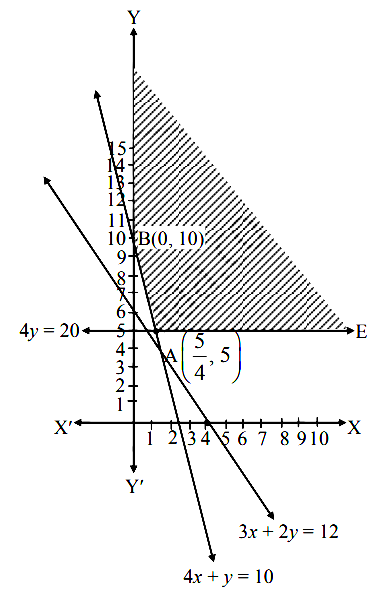
A chemist has a compound to be made using 3 basic elements X, Y, Z so that it has at least 10 litres of X, 12 litres of Y and 20 litres of Z. He makes this compound by mixing two compounds (I) and (II). Each unit compound (I) had 4 litres of X, 3 litres of Y. Each unit compound (II) had 1 litre of X, 2 litres of Y and 4 litres of Z. The unit costs of compounds (I) and (II) are ₹ 400 and ₹ 600 respectively. Find the number of units of each compound to be produced so as to minimize the cost
Answer

Let the chemist produce x units of compound I and y units of compound II.
Since x and y cannot be negative, x ≥ 0, y ≥ 0
The unit costs of compounds I and II are ₹ 400 and ₹ 600 respectively.
Total Cost = Z = 400x + 600y
We construct a table with constraints of X, Y and Z as follows:
  Compound I Compound II Least value
X 4 1 10
Y 3 2 12
Z 4 20
From the table, the constraints are
4x + y ≥ 10
3x + 2y ≥ 12
4y ≥ 20
Given problem can be formulated as follows:
Minimize Z = 400x + 600y
Subject to 4x + y ≥ 10
3x + 2y ≥ 12
4y ≥ 20, x ≥ 0, y ≥ 0
To draw the feasible region, construct table as follows:
Inequality $4 x+y \geq 10$ $3 x+2 y \geq 12$ $4 y \geq 20$
Corresponding equation (of line) 4x + y = 10 3x + 2y = 12 4y = 20
Intersection of line with X-axis $\left(\frac{5}{2}, 0\right)$ (4, 0)
Intersection of line with Y-axis (0, 10) (0, 6) (0, 5)
Region Non-Origin side Non-Origin side Non-Origin side
Shaded portion EABY is the feasible region, whose vertices are A and B(0, 10).
A is the point of intersection of the lines 4y = 20 and 4x + y = 10,
Solving the above equations, we get
$x=\frac{5}{4}, y=5$
$\therefore A \equiv\left(\frac{5}{4}, 5\right)$

Here, the objective function is
Z = 400x + 600y
$ \therefore \text { Z at } A\left(\frac{5}{4}, 5\right)=400\left(\frac{5}{4}\right)+600(5)$
$=500+3000$
$=3500$
$Z \text { at } B(0,10)=400(0)+600(10)$
$=6000 $
$\therefore Z$ has minimum value 3500 at $x=\frac{5}{4}$ and $y=5$
$\therefore$ The chemist should produce $\frac{5}{4}$ units of compound I and 5 units of compound II to minimize the cost.

Need a full question paper?

Generate a complete, print-ready paper with questions like this in minutes — across 16+ boards, with answer keys.

Start Generating Free

Similar questions

Solve the following equations by method of reduction :$x – 3y + z = 2 , 3x + y + z = 1$ and $5x + y + 3z = 3$
What is a tautology? What is a contradiction? Show that the negation of a tautology is a contradiction and the negation of a contradiction is a tautology.
Solve the following differential equation
$x^2 \frac{d y}{d x}=x^2+x y-y^2$
For each of the following differential equations find the particular solution : $\frac{d y}{d x}=4 x + y +1$, when $y =1, x =0$
Find the area of the circle $x^2 + y^2 = 6^2$
Find $k$, if $A=\left[\begin{array}{ll}3 & -2 \\ 4 & -2\end{array}\right]$ and $A^2=k A-2 l$.
x y $x-\bar{x}$ $y-\bar{y}$ $(x-\bar{x})(y-\bar{y})$ $(x-\bar{x})^2$ $(y-\bar{y})^2$
1 5 -2 -4 8 4 16
2 7 -1 -2 $\square$ 1 4
3 9 0 0 0 0 0
4 11 1 2 2 4 4
5 13 2 4 8 1 16
Total = 15 Total = 45 Total = 0 Total = 0 Total =$\square$ Total = 10 Total = 40
Mean of $x =\bar{x}=$$\square$
Mean of $y =\bar{y}=$$\square$
$ b_{x y}=\frac{\square}{\square}$
$b_{y x}=\frac{\square}{\square} $
Regression equation of $x$ on $y$ is $(x-\bar{x})= b _{x y}(y-\bar{y})$
$\therefore$ Regression equation $x$ on $y$ is$\square$
Regression equation of $y$ on $x$ is $(y-\bar{y})= b _{y x}(x-\bar{x})$
$\therefore$ Regression equation of $y$ on $x$ is$\square$
A die is thrown $4$ times. If ‘getting an odd number’ is a success, find the probability of at most $2$ successes
A company manufactures 2 types of goods P and Q that requires copper and brass. Each unit of type P requires 2 grams of brass and 1 gram of copper while one unit of type Q requires 1 gram of brass and 2 grams of copper. The company has only 90 grams of brass and 80 grams of copper. Each unit of types P and Q brings profit of ₹ 400 and ₹ 500 respectively. Find the number of units of each type the company should produce to maximize its profit
A merchant takes a fire insurance policy to cover 80% of the value of his stock. Stock worth ₹ 80,000 was completely destroyed in a fire. While the rest of the stock was reduced to 20% of its value. If the proportional compensation under the policy was ₹ 67,200, find the value of the stock.