MCQ
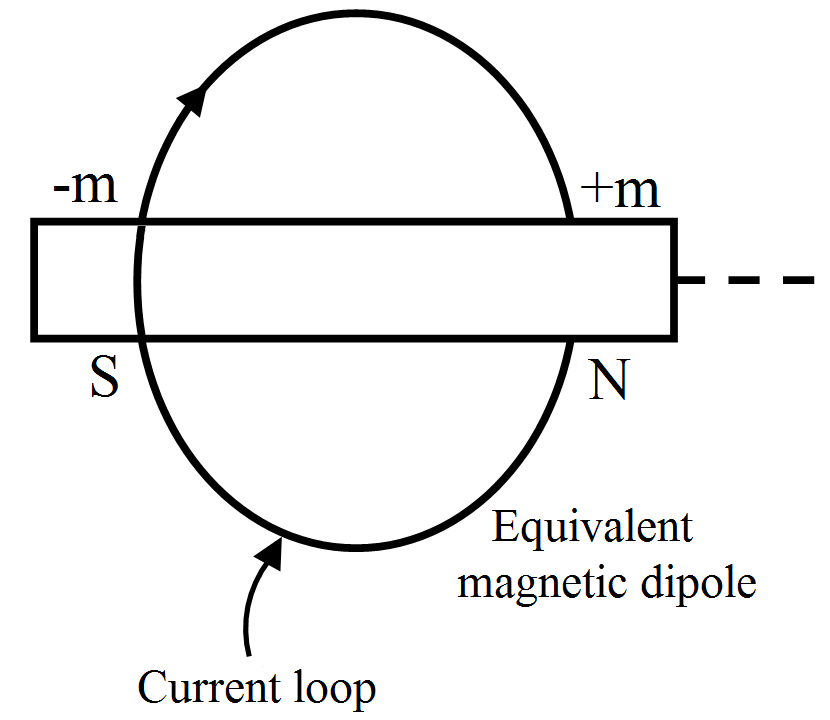
A circular loop carrying a current is replaced by ann equivalent magnetic dipole. A point on the axis of the loop is in:
  • End-on position.
  • B
    Broadside-on position.
  • C
    Both.
  • D
    None.

Answer

Correct option: A.
End-on position.


Points lying on the axis of a magnet are called end-on points. In our case, the point on the axis of the loop (on replacing the circular loop with an equivalent magnetic dipole) lies on the axis of the magnetic dipole or on the end-on position.

If P was the point on the axis of the loop, then it is clear from the figure that P lies on the end-on position of the equivalent magnetic dipole.

Need a full question paper?

Generate a complete, print-ready paper with questions like this in minutes — across 16+ boards, with answer keys.

Start Generating Free

Similar questions

Inside a parallel plate capacitor the electric field $E$ varies with time as $t^2$. The variation of induced magnetic field with time is given by
The radioactivity of a certain radioactive element drops to $1/64$ of its initial value in $30\, seconds$. Its half life is .........$seconds$
The far point of a myopic person is $80\, cm$ in front of the eye. What is the eye power of the lens required to enable him to see very distant objects clearly? 
A nucleus with $Z = 92$ emits the following in a sequence: $\alpha ,\,{\beta ^ - },\,{\beta ^ - },\,\alpha ,\alpha ,\alpha ,\alpha ,\alpha ,{\beta ^ - },\,{\beta ^ - },\alpha ,\,{\beta ^ + },\,{\beta ^ + },\,\alpha $. The $Z$ of the resulting nucleus is
The distance of the eye$-$lens from the retina is $x$. For a normal eye, the maximum focal length of the eye$-$lens:
A star initially has ${10^{40}}$ deuterons. It produces energy via the processes

$_1{H^2}{ + _1}{H^2}{ \to _1}{H^3} + p$

$_1{H^2}{ + _1}{H^3}{ \to _2}H{e^4} + n$

The masses of the nuclei are as follows :

$M({H^2}) = 2.014\;amu;\;M(p) = 1.007\;amu;$

$M(n) = 1.008\;amu;\;M(H{e^4}) = 4.001\;amu$

If the average power radiated by the star is ${10^{16}}W$,the deuteron supply of the star is exhausted in a time of the order of

An equilateral prism deviates a ray through $40^o$ for two angles of incidence differing by $20^o$. The possible angles of incidences are :
For a real object, which of the following can produced a real image
The de-Broglie wavelength associated with the electron in the $n\, = 4$ level is
Assertion : Energy is released in nuclear fission.

Reason : Total binding energy of the fission fragments is larger than the total binding energy of the parent nucleus