Question
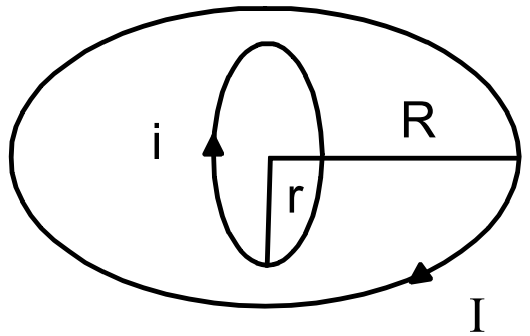
A circular loop of radius R carries a current I. Another circular loop of radius r ( << R) carries a current i and is placed at the centre of the larger loop. The planes of the two circles are at right angle to each other. Find the torque acting on the smaller loop.
Answer

$\overrightarrow{\text{B}}$ Large loop $=\frac{\mu_0\text{I}}{2\text{R}}$
'i’ due to larger loop on the smaller loop$=\text{i}(\text{A}\times\text{B})=\text{i}\text{AB}\ \sin90^\circ=\text{i}\times\pi\text{r}^2\times\frac{\mu_0\text{I}}{2\text{r}}$

Need a full question paper?

Generate a complete, print-ready paper with questions like this in minutes — across 16+ boards, with answer keys.

Start Generating Free

Similar questions

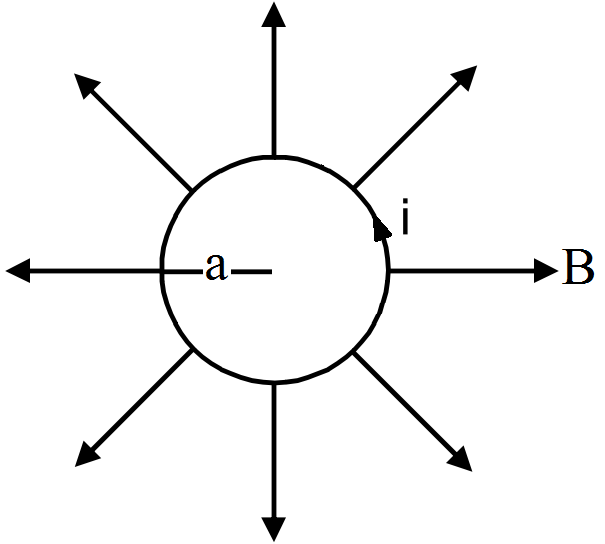
A circular loop of radius a, carrying a current i, is placed in a two-dimensional magnetic field. The centre of the loop coincides with the centre of the field The strength of the magnetic field at the periphery of the loop is B. Find the magnetic force on the wire.
The driver of a truck travelling with a velocity v suddenly notices a brick wall in front of him at a distance d. Is it better for him to apply brakes or to make a circular turn without applying brakes in order to just avoid crashing into the wall? Why?
A projectile is thrown at an angle of 60° with the horizontal. After how much time will its inclination with the horizontal be 45°? [Given $|\vec{\text{v}}|=147\text{ m/s}]$
The intensity of sound in a normal conversation at home is about $3 \times 10^{-6} Wm ^{-2}$ and the frequency of normal human voice is about $1000 Hz$ . Find the amplitude of waves, assuming that the air is at standard conditions.
Two small bodies of masses 2.00kg and 4.00kg are kept at rest at a separation of 2.0m. Where should a particle of mass 0.10kg be placed to experience no net gravitational force from these bodies? The particle is placed at this point. What is the gravitational potential energy of the system of three particles with usual reference level?
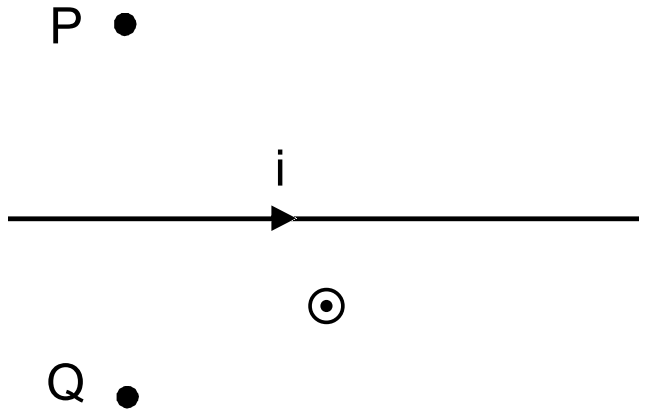
A long, straight wire carrying a current of 1.0A is placed horizontally in a uniform magnetic field B = $1.0 \times 10^{-5}T$ pointing vertically upward figure. Find the magnitude of the resultant magnetic field at the points Pand Q, both situated at a distance of 2.0cm from the wire in the same horizontal plane.
The bob A of a pendulum released from 30° to the vertical hits another bob B of the same mass at rest on a table as shown in. How high does the bob A rise after the collision? Neglect the size of the bobs and assume the collision to be elastic.
For an oscillating pendulum, establish the relation, $\frac{\text{d}^2\theta}{\text{dr}^2}+\omega^2=\theta=0,$ Where $\omega^2=\frac{\text{g}}{\text{l}}$ and $\theta$ is small angular displacement.
Consider a 10cm long piece of a wire which carries a current of 10A. Find the magnitude of the magnetic field due to the piece at a point which makes an equilateral triangle with the ends of the piece.
What will be the mean free path of nitrogen gas at STP of given diameter of nitrogen molecule $=2\mathring{\text{A}}?$