MCQ
A clamped string is oscillating in $n^{th}$ harmonic, then
  • A
    total energy of oscillations will be $n^2$ times that of fundamental frequency
  • B
    total energy of oscillations will be $(n-1)^2$ times that of fundamental frequency
  • C
    average kinetic energy of the string over a complete oscillations is half of that of the total energy of the string.
  • both $(A)$ and $(C)$

Answer

Correct option: D.
both $(A)$ and $(C)$
d
For a sine wave, $y=A \sin (k x-\Omega t)$

Velocity equation for this wave is $V_{y}=\Omega A \cos (k x-\Omega t)$ Kinetic energy $=d(K E)=1 / 2\left(V_{y}^{2} \times d m\right)=1 / 2\left(V_{y}^{2} \times \mu d x\right), \mu$ is the linear mass density.

$\Rightarrow 1 / 2\left(\mu \times \Omega^{2} \times A^{2} \times \cos ^{2}(k x-\Omega t)\right) d x$

integrating at $t=0,$ with limits as 0 and $\lambda,$ we have

$K . E=1 / 4\left(\mu \times \Omega^{2} \times A^{2} \times \lambda\right)$

Potential energy, $d U=1 / 2\left(\Omega^{2} \times y^{2} \times \mu\right) d x$

integrating at $t=0,$ with limits as 0 and $\lambda,$ we have $U=1 / 4\left(\mu \times \Omega^{2} \times A^{2} \times \lambda\right)$

Total energy $E=K . E+U$ $\Rightarrow E=1 / 2\left(\mu A^{2} \lambda\right)$

Therefore, for the first and fundamental frequency, energy is $E_{1}=\left(1 / 2\left(\mu A^{2} \lambda\right)\right) / n^{2}$

And clearly from the above derivation, we have, $K.E$ is half the total energy.
Need a full question paper?

Generate a complete, print-ready paper with questions like this in minutes — across 16+ boards, with answer keys.

Start Generating Free

Similar questions

A mass m oscillates with simple harmonic motion with frequency $f = \frac{\omega }{{2\pi }}$ and amplitude A on a spring with constant $K$ , therefore
Two parallel beams of electrons moving in the same direction produce a mutual force
The speed of sound in a gas, in which two waves of wavelength $1.0\,\, m$ and $1.02\,\, m$ produce $6$ beats per second, is approximately .... $m/s$
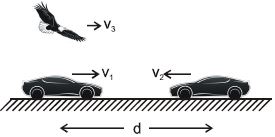
A bird flies to and fro between two cars which move with velocity $v_1 = 20\, m/s$ and $v_2 = 30\, m/s$. If the speed of the bird is $v_3 = 10\, m/s$ and the initial distance of  separation between them is $d = 2\, km$, find the total distance covered by the bird till  the cars meet.........$m$
What is incorrect for current carrying solenoid
A system has basic dimensions as density $[D]$, velocity $[V]$ and area $[A]$. The dimensional representation of force in this system is 
A monkey of mass $40 \,kg$ climbs up a rope, of breaking load $600 \,N$ hanging from a ceiling. If it climbs up the rope with the maximum possible acceleration, then the time taken by monkey to climb up is .........$s$ [Length of rope is $10 \,m$ ]
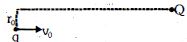
A point chargr $Q$ is fixed A small charge $q$ and mass $m$ is given a velocity $v_0$ from infinity & perpendicular distance $r_0$ as shown. If distance of closest approach is $r_0/2$. The value of $q$ is [Given $mv_0^2 = \frac{{{Q^2}}}{{4\pi { \in _0}\,{r_0}}}$]
A submarine has a window of area $30 \times 30 \,cm ^2$ on its ceiling and is at a depth of $100 \,m$ below sea level in a sea. If the pressure inside the submarine is maintained at the sea-level atmosphere pressure, then the force acting on the window is ............. $N$ (consider density of sea water $=1.03 \times 10^3 \,kg / m ^3$, acceleration due to gravity $=10 \,m / s ^2$ )
In Young's double slit experiment, when two light waves form third minimum, they have