MCQ
A clamped string is oscillating in $n^{th}$ harmonic, then
  • A
    total energy of oscillations will be $n^2$ times that of fundamental frequency
  • B
    total energy of oscillations will be $(n-1)^2$ times that of fundamental frequency
  • C
    average kinetic energy of the string over a complete oscillations is half of that of the total energy of the string.
  • both $(A)$ and $(C)$

Answer

Correct option: D.
both $(A)$ and $(C)$
d
For a sine wave, $y=A \sin (k x-\Omega t)$

Velocity equation for this wave is $V_{y}=\Omega A \cos (k x-\Omega t)$ Kinetic energy $=d(K E)=1 / 2\left(V_{y}^{2} \times d m\right)=1 / 2\left(V_{y}^{2} \times \mu d x\right), \mu$ is the linear mass density.

$\Rightarrow 1 / 2\left(\mu \times \Omega^{2} \times A^{2} \times \cos ^{2}(k x-\Omega t)\right) d x$

integrating at $t=0,$ with limits as 0 and $\lambda,$ we have

$K . E=1 / 4\left(\mu \times \Omega^{2} \times A^{2} \times \lambda\right)$

Potential energy, $d U=1 / 2\left(\Omega^{2} \times y^{2} \times \mu\right) d x$

integrating at $t=0,$ with limits as 0 and $\lambda,$ we have $U=1 / 4\left(\mu \times \Omega^{2} \times A^{2} \times \lambda\right)$

Total energy $E=K . E+U$ $\Rightarrow E=1 / 2\left(\mu A^{2} \lambda\right)$

Therefore, for the first and fundamental frequency, energy is $E_{1}=\left(1 / 2\left(\mu A^{2} \lambda\right)\right) / n^{2}$

And clearly from the above derivation, we have, $K.E$ is half the total energy.
Need a full question paper?

Generate a complete, print-ready paper with questions like this in minutes — across 16+ boards, with answer keys.

Start Generating Free

Similar questions

Four particles each of mass $M$, are located at the vertices of a square with side $L$. The gravitational potential due to this at the centre of the square is
The ratio of the distances travelled by a freely falling body in the $1^{\text {st }}, 2^{\text {nd }}, 3^{\text {rd }}$ and $4^{\text {th }}$ second :
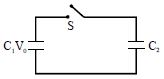
A capacitor of capacity $C_1$ is charged to the potential of $V_0$. After disconnecting with the battery, it is connected with a neutral capacitor of capacity $C_2$ as shown in the adjoining figure. The ratio of energy of system before and after the connection of switch $S$ will be
Two equally charged, identical metal spheres $A$ and $B$ repel each other with a force '$F$'. The spheres are kept fixed with a distance '$r$' between them. A third identical, but uncharged sphere $C$ is brought in contact with $A$ and then placed at the mid-point of the line joining $A$ and $B$. The magnitude of the net electric force on $C$ is
An engine giving whistle is moving towards a stationary observer with $110\,m/s$ speed. What will be the ratio of the frequency of the whistle heard when the engine is approaching and receding from the observer? (the speed of sound is $330\,m/s$ )
A particle excutes $SHM$ on a straight line path. The amplitude of oscillation is $2\,cm$. When the displacement of the particle from the mean position is $1\,cm$, the numerical value of magnitude of acceleration is equal to the numerical value of magnitude of velocity. The frequency of $SHM$ is (in $second^{-1}$)
The breaking stress of aluminium is $7.5 \times 10^7 \,Nm ^{-2}$. The greatest length of aluminium wire that can hang vertically without breaking is ......... $\times 10^3 \,m$ (Density of aluminium is $2.7 \times 10^3 \,kg m ^{-3}$ )
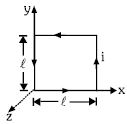
The magnetic field existing in a region is given by $\vec B\, = \,{B_0}\,\left( {5 + \frac{x}{l}} \right)\,\hat K$ A square loop of edge $l$ and carrying a current $i$ is placed with its edges parallel to $x-y$ axes. Find the magnitude of the net magnetic force experienced by the loop
A car is moving at a speed of $72\, km/hr.$  the diameter of its wheels is $0.5\, m.$  If the wheels are stopped in $20 $ rotations by applying brakes, then angular retardation produced by the brakes is ............ $ rad/s^2$
Two coherent sources $S_1$ and $S_2$ are separated by a distance four times the wavelength $\lambda$ of the source. The sources lie along y axis whereas a detector moves along $+ x$ axis. Leaving the origin and far off points the number of points where maxima are observed is