Question
A closed cubical box is completely filled with water and is accelerated horizontally towards right with an acceleration α. The resultant normal force by the water on the top of the box.
  1. Passes through the centre of the top.
  2. Passes through a point to the right of the centre.
  3. Passes through a point to the left of the centre.
  4. Pecomes zeros.

Answer

  1. Passes through a point to the left of the centre.
Explanation:
When the box is accelerated towards right, the water in the box experiences a pseudo force (ma) towards left, where m is the mass of water. So, the resultant normal force by the water on the top of the box passes through a point to the left of the centre.

Need a full question paper?

Generate a complete, print-ready paper with questions like this in minutes — across 16+ boards, with answer keys.

Start Generating Free

Similar questions

The penetration of light into the region of geometrical shadow is called (a) Polarisation(b) Interference(c) Diffraction(d) Refraction
       
The energy of the highest energy photon of Balmer series of hydrogen spectrum is close to(a) 13.6 eV(b) 3.4 eV(c) 1.5 eV   (d) 0.85 eV
       
When the intensity of light falling on a surface producing photoelectric effect is doubled, then :
A radioactive reaction is $92^{\mathrm{U}^{238}} \Rightarrow 82^{\mathrm{Pb}^{206}}.$ How many $\alpha$ and $\beta$ particles are emitted
In a Thomson set$-$up for the determination of e/m, electrons accelerated by $2.5\ kV$ enter the region of crossed electric and magnetic fields of strengths $3.6 \times 10^4 \mathrm{Vm}^{-1}$ and $1.2 \times 10^{-3} \mathrm{~T}$ respectively and go through undeflected. The measured value of e/m of the electron is equal to
A plane mirror produces an image that is:
If six identical cells each having an $e.m.f.$ of $6 V$ are connected in parallel, the $e.m.f.$ of the combination is
In hydrogen atom, an electron is revolving in the orbit of radius $0.53 \mathring A$ with $6.6 \times 10^{15}$ rotations/second. Magnetic field produced at the centre of the orbit is
An electromagnetic wave going through vacuum is described by $\text{E}=\text{E}_0\sin(\text{kx}-\omega\text{t})$ which of the following is/are independent of the wavelength?
  1. $\text{k}$
  2. $\omega$
  3. $\frac{\text{k}}{\omega}$
  4. $\text{k}\omega$
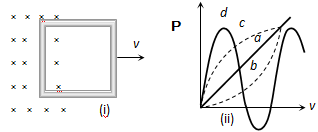
Figure $(i)$ shows a conducting loop being pulled out of a magnetic field with a speed $v.$ Which of the four plots shown in figure $(ii)$ may represent the power delivered by the pulling agent as a function of the speed $v$