MCQ
A closed cubical box is completely filled with water and is accelerated horizontally towards right with an acceleration α. The resultant normal force by the water on the top of the box.
  • A
    Passes through the centre of the top.
  • B
    Passes through a point to the right of the centre.
  • Passes through a point to the left of the centre.
  • D
    Pecomes zeros.

Answer

Correct option: C.
Passes through a point to the left of the centre.
Explanation:
When the box is accelerated towards right, the water in the box experiences a pseudo force (ma) towards left, where m is the mass of water. So, the resultant normal force by the water on the top of the box passes through a point to the left of the centre.

Need a full question paper?

Generate a complete, print-ready paper with questions like this in minutes — across 16+ boards, with answer keys.

Start Generating Free

Similar questions

In an ac circuit, current $I=5 \sin \left(100 t-\frac{\pi}{2}\right)$ ampere and altemating potential difference is $V =200$ sin ( 100 t ). The power dissipated in the circuit is :
Internal resistance of the cell is:
In helium nucleus, there are
In a hydrogen atom the electron makes a transition from $( n +1)^{\text {th }}$ level to the $n ^{\text {th }}$ level. If $n>>1,$ the frequency of radiation emitted is proportional to
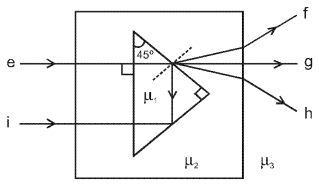
A right angled prism of refractive index $\mu_1$ is placed in a rectangular block of refractive index $\mu_2$, which is surrounded by a medium of refractive index $\mu_3$, as shown in the figure, A ray of ligth 'e' enters the rectangular block at normal incidence. Depending upon the relationships between $\mu_1, \mu_2$ and $\mu_3$, it takes one of the four possible paths $'ef', 'eg', 'eh'$ or $'ei'$. $Image$

Match the paths in List $I$ with conditions of refractive indices in List $II$ and select the correct answer using the codes given below the lists :

List $I$ List $II$
$P$. $\quad e \rightarrow f$ $1.$ $\quad \mu_1>\sqrt{2} \mu_2$
$Q.$ $\quad e \rightarrow g$ $2.$ $\quad \mu_1>\mu_1$ and $\mu_2>\mu_3$
$R.$ $\quad e \rightarrow h$ $3.$ $\quad \mu_1=\mu_2$
$S.$ $\quad e \rightarrow i$ $4.$ $\quad \mu_2<\mu_1<\sqrt{2} \mu_2$ and $\mu_2>\mu_3$

Codes: $\quad \quad P \quad Q \quad R \quad S $ 

A lamp emits monochromatic green light uniformly in all directions. The lamp is 3% efficient in converting electrical power to electromagnetic waves and consumes 100W of power. The amplitude of the electric field associated with the electromagnetic radiation at a distance of 10m from the lamp will be
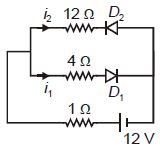
$D_1$ and $D_2$ are two ideal diodes. Value of $i_1$ and $i_2$ are
The ratio of the energy of an $X-$ray photon of wavelength $1 \mathring A$ to that of visible light of wavelength $5000 \mathring A$ is
Two identical coaxial circular loops carry a current $i$ each circulating in the same direction. If the loops approach each other
$L, C$ and $R$ represent physical quantities inductance, capacitance and resistance. The combination which has the dimensions of frequency is