MCQ
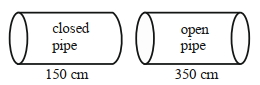
A closed organ pipe $150 \mathrm{~cm}$ long gives $7$ beats per second with an open organ pipe of length $350 \mathrm{~cm}$, both vibrating in fundamental mode. The velocity of sound is_________ $\mathrm{m} / \mathrm{s}$.
  • A
    $754$
  • B
    $654$
  • $294$
  • D
    $354$

Answer

Correct option: C.
$294$
c
$ \mathrm{f}_{\mathrm{c}}=\frac{\mathrm{v}}{4 \ell_1} \quad \mathrm{f}_{\mathrm{o}}=\frac{\mathrm{v}}{2 \ell_2} $

$ \left|\mathrm{f}_{\mathrm{c}}-\mathrm{f}_0\right|=7 $

$ \frac{\mathrm{v}}{4 \times 150}-\frac{\mathrm{v}}{2 \times 350}=7 $

$ \frac{\mathrm{v}}{600 \mathrm{~cm}}-\frac{\mathrm{v}}{700 \mathrm{~cm}}=7 $

$ \frac{\mathrm{v}}{6 \mathrm{~m}}-\frac{\mathrm{v}}{7 \mathrm{~m}}=7 $

$ \mathrm{v}\left(\frac{1}{42}\right)=7 $

$ \mathrm{v}=42 \times 7 $

$ =294 \mathrm{~m} / \mathrm{s}$

Need a full question paper?

Generate a complete, print-ready paper with questions like this in minutes — across 16+ boards, with answer keys.

Start Generating Free

Similar questions

A body of mass $2\, kg$ travels according to law $x = at + bt^2 + ct^3$, where $a = 3\, m/s$, $b = 4\,m/s^2$ and $c = 5\, m/s^3$, then force acting on body at $t = 2\, s$  ......... $N$.
A one metre long (both ends open) organ pipe is kept in a gas that has double the density of air at $STP$. Assuming the speed of sound in air at $STP$ is $300\; \mathrm{m} / \mathrm{s}$, the frequency difference between the fundamental and second harmonic of this pipe is ___ $\mathrm{Hz}$
There is no atmosphere on the moon because
A force of $2\hat i + 3\hat j + 4\hat k\;N$acts on a body for $4$ second, produces a displacement of $(3\hat i + 4\hat j + 5\hat k)m.$The power used is.......$W$
At which temperature the r.m.s. velocity of a hydrogen molecule equal to that of an oxygen molecule at $47^{\circ} \mathrm{C}$ ?
Which of the following statement is incorrect regarding mass?
A roller coaster is designed such that riders experience "weightlessness" as they go round the top of a hill whose radius of curvature is $20\, m.$ The speed of the car at the top of the hill is between
Two equal masses are attached to the two ends of a spring of spring constant $k.$ The masses are pulled out symmetrically to stretch the spring by a length $x$ over its natural length. The work done by the spring on each mass is:
A  particle of mass  $m$ is projected with velocity $v$ making an angle of $45^o $ with the horizontal. When the particle lands on the level ground the magnitude of the change in its momentum will be
A spherically symmetric gravitational system of particles has a mass density

$\rho=\left\{\begin{array}{l}\rho_0 \text { for } r \leq R \\ 0 \text { for } r>R\end{array}\right.$

where $\rho_0$ is a constant. A test mass can undergo circular motion under the influence of the gravitational field of particles. Its speed $V$ as a function of distance $\mathrm{r}(0<\mathrm{r}<\infty)$ from the centre of the system is represented by