A coil develops heat of $800\, cal/sec$. When $20\, volts$ is applied across its ends. The resistance of the coil is .............. $\Omega$ ($1$ $cal$ = $4.2$ $joule$)
Medium
Download our app for free and get started
(c) $H = \frac{{{V^2}t}}{{4.2\,R}}$ or $\frac{H}{t} = \frac{{{V^2}}}{{4.2\,R}}$
$ \Rightarrow $ $800 = \frac{{20 \times 20}}{{4.2 \times R}}$$ \Rightarrow $$R = \frac{5}{{42}} = 0.119 \approx 0.12\,\Omega $
$ \Rightarrow $ $800 = \frac{{20 \times 20}}{{4.2 \times R}}$$ \Rightarrow $$R = \frac{5}{{42}} = 0.119 \approx 0.12\,\Omega $

Download our appand get started for free
Experience the future of education. Simply download our apps or reach out to us for more information. Let's shape the future of learning together!No signup needed.*
Similar Questions
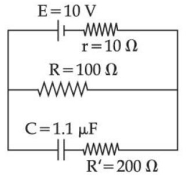
- 1As show in the figure, in steady state, the charge stored in the capacitor is....... $\times 10^{-6}\,C$.View Solution
- 2Heat produced in a wire of resistance $R$ due to current flowing at constant potential difference is proportional toView Solution
- 3A $50 \,W$ bulb connected in series with a heater coil is put to an $AC$ mains. Now the bulb is replaced by a $100 \,W$ bulb. The heater output will ...........View Solution
- 4Three resistances $P, Q, R$ each of $2 \,\,\Omega$ and an unknown resistance $S$ form the four arms of a Wheatstone bridge circuit. When a resistance of $6 \,\,\Omega$ is connected in parallel to $S$ the bridge gets balanced. What is the value of $S\,?$ ............... $\Omega$View Solution
- 5The combination of two identical cells, whether connected in series or parallel combination provides the same current through an external resistance of $2 \,\Omega$. The value of internal resistance of each cell is ............ $\Omega$View Solution
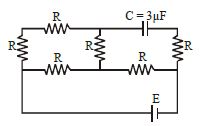
- 6In steady state the potential difference across the capacitor is $10\,\, V.$ Each resistance is of $3\,\Omega $. The cell is ideal. The $emf$ of the cell is .............. $\mathrm{V}$View Solution
- 7When two resistance $R_1$ and $R_2$ connected in series and introduced into the left gap of a meter bridge and a resistance of $10 \Omega$ is introduced into the right gap, a null point is found at $60 cm$ from left side. When $R_1$ and $R_2$ are connected in parallel and introduced into the left gap, a resistance of $3 \Omega$ is introduced into the right-gap to get null point at 40 cm from left end. The product of $R_1 R_2$ is $.............\Omega$View Solution
- 8A bulb rated at ($100\,W$ - $200\,V$) is used on a $100\,V$ line. The current in the bulb isView Solution
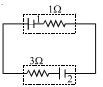
- 9In the figure shown, battery $1$ has $\mathrm{emf}$ $= 6\, V$ and internal resistance $= 1 \,\Omega$. Battery $2$ has $\mathrm{emf}$ $= 2\,V$ and internal resistance $= 3\, \Omega$ . The wires have negligible resistance. What is the potential difference across the terminals of battery $2$ ? ................ $V$View Solution
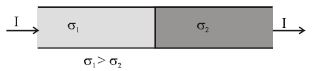
- 10Current $I$ is flowing through the two materials having electrical conductivities $\sigma_1$ and $\sigma_2$ respectively $(\sigma_1 > \sigma_2 )$ as shown in the figure. The total amount of charge at the junction of the materials isView Solution