Question
A collision experiment is done on a horizontal table kept in an elevator. Do you expect a change in the results if the elevator is accelerated up or down because of the noninertial character of the frame?

Answer

Velocity and mass are only two components that affect collision between two bodies so in this change in acceleration due to gravity will not affect the collision between two bodies. (if kept horizontally)

Need a full question paper?

Generate a complete, print-ready paper with questions like this in minutes — across 16+ boards, with answer keys.

Start Generating Free

Similar questions

The magnetometer of the previous problem is used with the same magnet in $\tan-\text{B}$ position. Where should the magnet be placed to produce a 37° deflection of the needle?
An AC source is connected to a diode and a resistor in series. Is the current thorough the resistor AC or DC?
Refer to the previous problem. Suppose, the goldsmith argues that he has not mixed copper or any other material with gold, rather some cavities might have been left inside the ornament. Calculate the volume of the cavities left that will allow the weights given in that problem.
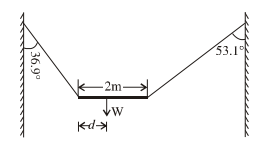
A non-uniform bar of weight W is suspended at rest by two strings of negligible weight as shown in Fig. The angles made by the strings with the vertical are 36.9º and 53.1º respectively. The bar is 2 m long. Calculate the distance d of the centre of gravity of the bar from its left end.
Image
A magnetic dipole of magnetic moment $0.72\sqrt{2}\text{ A-m}^2$ -is placed horizontally with the north pole pointing towards east. Find the position of the neutral point if the horizontal component of the earth's magnetic field is $18\mu\text{T.}$
A player hits a baseball at some angle. The ball goes high up in space. The player runs and catches the ball before it hits the ground. Which of the two (the player or the ball) has greater displacement?
The magnetic field due to the earth has a horizontal component of $26\mu\text{T}$ at a place where the dip is 60°. Find the vertical component and the magnitude of the field.
Read the passage given below and answer the following questions from 1 to 5.
When we speak, the sound moves outward from us, without any flow of air from one part of the medium to another. The disturbances produced in air are much less obvious and only our ears or a microphone can detect them. These patterns, which move without the actual physical transfer or flow of matter as a whole, are called waves. The most familiar type of waves such as waves on a string, water waves, sound waves, seismic waves, etc. is the so-called mechanical waves. These waves require a medium for propagation, they cannot propagate through vacuum. They involve oscillations of constituent particles and depend on the elastic properties of the medium. The electromagnetic waves that you will learn in Class XII are a different type of wave. Electromagnetic waves do not necessarily require a medium – they can travel through vacuum. Light, radio waves, X-rays, are all electromagnetic waves. We have seen that motion of mechanical waves involves oscillations of constituents of the medium. If the constituents of the medium oscillate perpendicular to the direction of wave propagation, we call the wave a transverse wave. If they oscillate along the direction of wave propagation, we call the wave a longitudinal wave. In transverse waves, the particle motion is normal to the direction of propagation of the wave. Therefore, as the wave propagates, each element of the medium undergoes a shearing strain. Transverse waves can, therefore, be propagated only in those media, which can sustain shearing stress, such as solids and not in fluids. Fluids, as well as, solids can sustain compressive strain; therefore, longitudinal waves can be propagated in all elastic media.
For example, in medium like steel, both transverse and longitudinal waves can propagate, while air can sustain only longitudinal waves. Answer the following.
  1. Air can sustain:
  1. Transverse waves
  2. Longitudinal waves
  3. Both a and b
  4. None of these
  1. The electromagnetic waves can pass through
  1. Solids only
  2. Fluids only
  3. Any medium even through vacuum
  4. None of these
  1. Define Transverse waves
  1. Define longitudinal waves
  1. Differentiate between Transverse waves and longitudinal waves
A triode value operates at Vp = 225V and Vg = -0.5V. The plate current remains unchanged if the plate voltage is increased to 250V and the grid voltage is decreased to -2.5V. Calculate the amplification factor.