MCQ
A completely inelastic collision is one in which the two colliding particles
  • A
    Are separated after collision
  • Remain together after collision
  • C
    Split into small fragments flying in all directions
  • D
    None of the above

Answer

Correct option: B.
Remain together after collision
b
(b) Completely inelastic collision is one in which the coefficient of restitution is zero.

Coefficient of restitution means the speed of separation of particles is zero.

Thus the two particles remain together after collision.

Need a full question paper?

Generate a complete, print-ready paper with questions like this in minutes — across 16+ boards, with answer keys.
Start Generating Free

Similar questions

Two tuning forks $A\,\, \& \,\,B$ produce notes of frequencies $256 Hz \,\,\& \,\,262 Hz$ respectively. An unknown note sounded at the same time as $A$ produces beats . When the same note is sounded with $B$, beat frequency is twice as large . The unknown frequency could be  ... $Hz$
The rms speed of oxygen molecule in a vessel at particular temperature is $\left(1+\frac{5}{x}\right)^{\frac{1}{2}} v$, where $v$ is the average speed of the molecule. The value of $x$ will be:(Take $\pi=\frac{22}{7}$ )
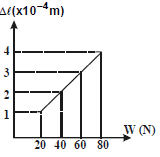
The adjacent graph shows the extension $(\Delta l)$ of a wire of length $1\, m$ suspended from the top of a roof at one end and with a load $W$   connected to the other end. If the cross-sectional area of the wire is $10^{-6}\, m^2$, calculate the Young’s modulus of the material of the wire.
A bullet of mass $0.01\, kg$ and travelling at a speed of $500 \,m/s$. strikes a block of  mass $2 \,kg$. which is suspended by a string of length $5\,m$. The centre of gravity of the  block is found to raise a vertical distance of $0.1\,m$. What is the speed of the bullet  after it emerges from the block- ................ $\mathrm{m}/ \mathrm{s}$
Two semicircular rings of linear mass densities $\lambda $ and $3\lambda $ and of radius $R$ each are joining to form a complete ring. The distance of the centre of the mass of complete ring from its geometrical centre is
A block of mass $M$ is hanging over a smooth and light pulley through a light string. The other end of the string is pulled by a constant force $F$. The kinetic energy of the block increases by $20\,J$ in $1\, s$.
Four identical spheres each of mass $m$ are placed at the corners of square of side $2\,metre$. Taking the point of intersection of the diagonals as the origin, the co-ordinates of the centre of mass are
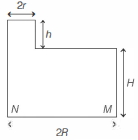
A cylindrical vessel of base radius $R$ and height $H$ has a narrow neck of height $h$ and radius $r$ at one end (see figure). The vessel is filled with water (density $\rho_w$ ) and its neck is filled with immiscible oil (density $\rho_0$ ). Then, the pressure at
Mercury is filled in a tube of radius $2 \mathrm{~cm}$ up to a height of $30 \mathrm{~cm}$. The force exerted by mercury on the bottom of the tube is. . . . . . $\mathrm{N}$.

(Given, atmospheric pressure $=10^5 \mathrm{Nm}^{-2}$, density of mercury $=1.36 \times 10^4 \mathrm{~kg} \mathrm{~m}^3, \mathrm{~g}=10 \mathrm{~ms}^2$, $\left.\pi=\frac{22}{7}\right)$

An inductor, a resistance and a capacitor are joined in series with an AC source. As the frequency of the source is slightly increased from a very low value, the reactance:
  1. Of the inductor increases.
  2. Of the resistor increases.
  3. Of the capacitor increases.
  4. Of the circuit increases.