MCQ
A composition string is made up by joining two strings of different masses per unit length $\rightarrow \mu$ and $4\mu$ . The composite string is under the same tension. A transverse wave pulse $: Y = (6 mm) \,\,sin\,\,(5t + 40x),$ where $‘t’$ is in seconds and $‘x’$ in meters, is sent along the lighter string towards the joint, the percentage of power transmitted to the heavier string through the joint is approximately ..... $\%$
  • A
    $33$
  • $89$
  • C
    $67$
  • D
    $75$

Answer

Correct option: B.
$89$
b
Power, $P=\frac{1}{2} \mu \omega^{2} A^{2} v$

Amplitude of transmitted wave, $A_{t}=\frac{2 Z_{1}}{Z_{1}+Z_{2}} A=\frac{2 \sqrt{\mu T}}{\sqrt{\mu T}+\sqrt{4 \mu T}} A=\frac{2}{3} A$

Thus, $P=\frac{1}{2} \mu \omega^{2} A^{2} v$

$=\frac{1}{2} \times 4 \mu \times \omega^{2} \times \frac{4 A^{2}}{9} \times \sqrt{\frac{T}{4 \mu}}=\left(\frac{1}{2} \times \mu \times \omega^{2} \times A^{2} \times \sqrt{\frac{T}{\mu}}\right) \times \frac{8}{9}$

$=\frac{8}{9} \times$ Initial power

Thus power transmitted $=\frac{8}{9} \times 100=89 \%$

Need a full question paper?

Generate a complete, print-ready paper with questions like this in minutes — across 16+ boards, with answer keys.

Start Generating Free

Similar questions

The coefficient of friction between tyres and the road is $0.1.$ Find the maximum speed allowed by traffic police for cars to cross a circular turn of radius $10m$ to prevent accident.
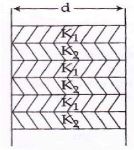
A wall consists of alternating blocks of length $d$ and coefficient of thermal conductivity $K_{1}$ and $K_{2}$ respectively as shown in figure. The cross sectional area of the blocks are the same. The equivalent coefficient of thermal conductivity of the wall between left and right is
Which of the following is true for a satellite in an orbit?
A wave is represented by the equation$y = 7\sin \left( {7\pi t - 0.04\,x\pi + \frac{\pi }{3}} \right)$ $x$ is in metres and $ t$ is in seconds. The speed of the wave is
A bakelite beaker has volume capacity of $500\, cc$ at $30^{\circ} C$. When it is partially filled with $V _{ m }$ volume (at $30^{\circ}$ ) of mercury, it is found that the unfilled volume of the beaker remains constant as temperature is varied. If $\gamma_{\text {(beaker) }}=6 \times 10^{-6}{ }^{\circ} C ^{-1}$ and $\gamma_{(\text {mercury })}=1.5 \times 10^{-4}{ }^{\circ} C ^{-1},$ where $\gamma$ is the coefficient of volume expansion, then $V _{ m }($in $cc )$ is close to
A source, approaching with speed $u$ towards the open end of a stationary pipe of length $L$, is emitting a sound of frequency $f_5$. The farther end of the pipe is closed. The speed of sound in air is $v$ and $f_0$ is the fundamental frequency of the pipe. For which of the following combination(s) of $u$ and $f_5$, will the sound reaching the pipe lead to a resonance?

$(A)$ $u=0.8 v$ and $f_5=f_0$

$(B)$ $u=0.8 v$ and $f_5=2 f_0$

$(C)$ $u=0.8 v$ and $f_5=0.5 f_0$

$(D)$ $u=0.5 v$ and $f_5=1.5 f_0$

A stationary tuning fork is in resonance with an air column in a pipe. If the tuning fork is moved with a speed of $2 ms ^{-1}$ in front of the open end of the pipe and parallel to it, the length of the pipe should be changed for the resonance to occur with the moving tuning fork. If the speed of sound in air is $320 ms ^{-1}$, the smallest value of the percentage change required in the length of the pipe is. . . . . .
Velocity of a body moving along a straight line with uniform acceleration $a$ reduces by $\frac{3}{4}$ of its initial velocity in time $t_0$. The total time of motion of the body till its velocity becomes zero is
A particle $(A)$ moves due north at $3\,km / h$ another particle $(B)$ due west at $4\,km / h$. The relative velocity of $A$ with respect to $B$ is $\left(\tan 37^{\circ}=3 / 4\right)$
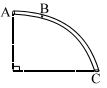
The tube $AC$ forms a quarter circle in a vertical plane. The ball $B$ has an area of cross-section slightly smaller than that of the tube, and can move without friction through it. $B$ is placed at $A$ and displaced slightly. It will