Question
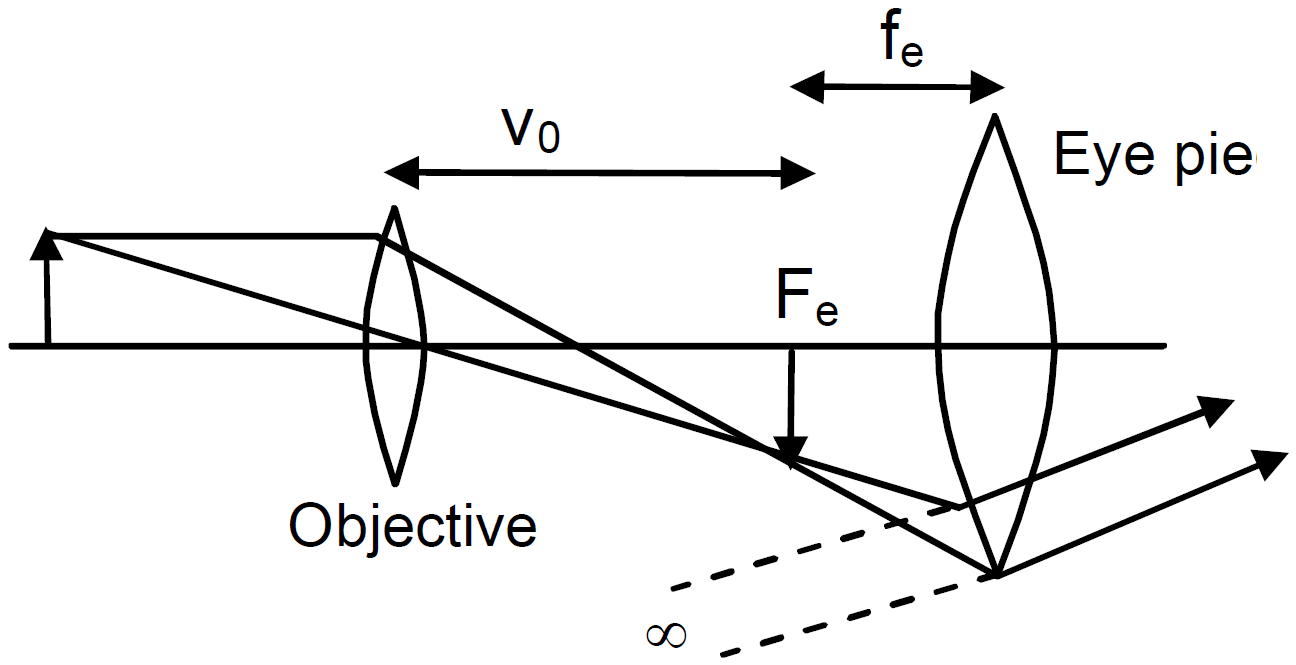
A compound microscope has a magnifying power of $100$ when the image is formed at infinity. The objective has a focal length of $0.5\ cm$ and the tube length is $6.5\ cm$. Find the focal length of the eyepiece.
Answer

For the give compound microscope $, f_0 = 0.5\ cm,$ tube length $= 6.5\ cm$ magnifying power $= 100 \ ($normal adjustment$)$
Since, the image is formed at infinity, the real image produced by the objective lens should lie on the focus of the eye piece.
So $, v_o + f_e = 6.5\ cm ...(1)$
Again, magnifying power $\text{m}=\frac{\text{v}_0}{\text{u}_0}\times\frac{\text{D}}{\text{f}_\text{e}} \ [$for normal adjustment$]$
$\Rightarrow\text{m}=\Big[1-\frac{\text{V}_0}{\text{f}_0}\Big]\frac{\text{D}}{\text{f}_\text{e}}$
$\Rightarrow100=-\Big[1-\frac{\text{V}_0}{0.5}\Big]\times\frac{25}{\text{f}_\text{e}} \ [$Taking $D = 25\ cm]$
$\Rightarrow100\text{f}_\text{e}=-(1-2\text{v}_0)\times25$
$\Rightarrow2\text{v}_0-4\text{f}_\text{e}=1 ...(2)$
Solving equation $(1)$ and $(2)$ we can get,
$V_0 = 4.5\ cm$ and $f_e = 2\ cm$
So, the focal length of the eye piece is $2\ cm.$​​​​​​​

Need a full question paper?

Generate a complete, print-ready paper with questions like this in minutes — across 16+ boards, with answer keys.

Start Generating Free

Similar questions

A light beam of wavelength $400$ run is incident on a metal plate of work function $2.2\ eV.$
  1. A particular electron absorbs a photon and makes two collisions before coming out of the metal. Assuming that $10\%$ of the extra energy is lost to the metal in each collision, find the kinetic energy of this electron as it comes out of the metal.
  2. Under the same assumptions, find the maximum number of collisions the electron can suffer before it becomes unable to come out of the metal.
​​​​​​​
The time constant of an LR circuit is 40ms. The circuit is connected at t = 10 and the steady-state current is found to be 2.0A. Find the current at:
  1. t = 10ms
  2. t = 20ms
  3. t = 100ms
  4. t = 1s.
Suppose $a 'n\ ' -$ type wafer is created by doping $Si$ crystal having $5 \times 10^{28} \text{atoms/m^3}$ with $1 \text{ppm}$ concentration of As. On the surface $200 \text{ppm}$ Boron is added to create $'P\ '$ region in this wafer. Considering $n_i = 1.5 \times 10^{16}m^{-3}$.
  1. Calculate the densities of the charge carriers in the $n\ p$ regions.
  2. Comment which charge carriers would contribute largely for the reverse saturation current when diode is reverse biased.
A circular coil of radius 2.00cm has 50 turns. A uniform magnetic field B - 0.200T exists in the space in a direction parallel to the axis of the loop. The coil is now rotated about a diameter through an angle of 60.0°. The operation takes 0.100s.
  1. Find the average emf induced in the coil.
  2. If the coil is a closed one (with the two ends joined together) and has a resistance of $4.00\Omega.$ calculate the net charge crossing a cross-section of the wire of the coil.
Explain the shortcomings of Rutherford's Atomic Model.###Write two shortcomings of Rutherford's Atomic Model.
In an imaginary atmosphere, the air exerts a small force $F$ on any particle in the direction of the particle's motion. A particle of mass $m$ projected upward takes a time $t_1$ in reaching the maximum height and $t_2$ in the return journey to the original point. Then:
Define the term ‘resolving power’ of an astronomical telescope. How does it get affected on:
  1. Increasing the aperture of the objective lens?
  2. Increasing the wavelength of light used?
  3. Increasing the focal length of the objective lens?
 Justify your answer in each case.
A hollow sphere of radius $2\ cm$ is attached to an $18\ cm$ long thread to make a pendulum. Find the time period of oscillation of this pendulum. How does it differ from the time period calculated using the formula for a simple pendulum?
What are N-type semiconductors? Their conductivity is higher than that of pure semiconductors. Why? Explain with figure.
An atom is in its excited state. Does the probability of its coming to ground state depend on whether the radiation is already present or not? If yes, does it also depend on the wavelength of the radiation present?