MCQ
$A$ concave mirror cannot form
  • virtual image of virtual object
  • B
    virtual image of a real object
  • C
    real image of a real object
  • D
    real image of a virtual object.

Answer

Correct option: A.
virtual image of virtual object
a
Virtual image cannot be formed from a virtual object.

When object is placed between pole and focus, image formed by the concave mirror is magnified, virtual and erect.

when object is placed beyond centre of curvature, image of it is formed between centre of curvature and focus which is diminished, real and inverted, so real image of real object can be formed by concave mirror.

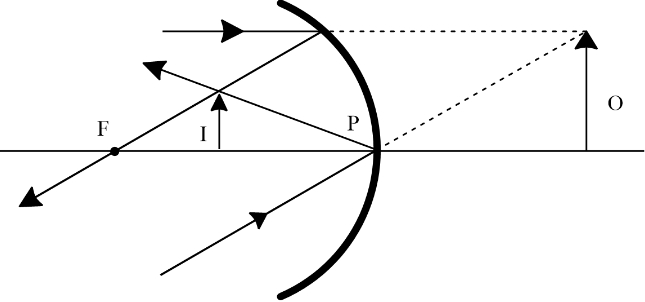
When object is virtual, image formed is real for concave surface as shown in figure.
Need a full question paper?

Generate a complete, print-ready paper with questions like this in minutes — across 16+ boards, with answer keys.
Start Generating Free

Similar questions

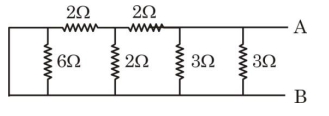
Equivalent resistance of the following network is____ $\Omega$.
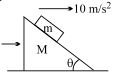
In the figure shown all the surfaces are frictionless, and mass of the block, $m = 1\, kg$. The block and wedge are held initially at rest. Now wedge is given a horizontal acceleration of $10\, m/s^2$ by applying a force on the wedge, so that the block does not slip on the wedge. Then work done by the normal force in ground frame on the block in $\sqrt 3 $ seconds is ......... $J$
An alternating supply of $220\,V$ is applied across a circuit with resistance $22\,\Omega $ and impedance $44\,\Omega $. The power dissipated in the circuit is.........$W$
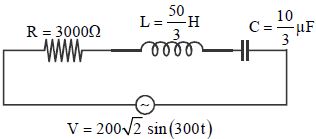
The average power consumed by the given circuit is......$W$
In gold foil experiment number of deflected $\alpha -$ particles at angle $90^o$ is $63$ than number of $\alpha -$ particle deflected at $120^o$ is
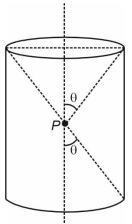
A charge is kept at the central point $P$ of a cylindrical region. The two edges subtend a half-angle $\theta$ at $P$, as shown in the figure. When $\theta=30^{\circ}$, then the electric flux through the curved surface of the cylinder is $\Phi$ If $\theta=60^{\circ}$, then the electric flux through the curved surface becomes $\Phi / \sqrt{n}$, where the value of $n$ is. . . . . . .
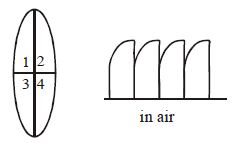
The given lens is broken into four parts rearranged as shown. If the initial focal length is $f$, then after rearrangement the equivalent focal length is
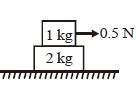
A force of $0.5\ N$ is applied on the upper block as shown in figure. The coefficient of static friction between the two blocks is $0.1$ and that between the lower block and the surface is zero. The work done by the lower block on the upper block for a displacement of $3\ m$ of the upper block is ...... $J$
Work done in converting $1\, g$ of ice at $-10\,^oC$ into steam at $100\,^oC$ is ......... $J$
An electron enters a magnetic field whose direction is perpendicular to the velocity of the electron. Then