MCQ
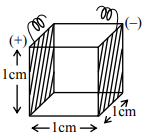
A conductivity cell with two electrodes (dark side) are half filled with infinitely dilute aqueous solution of a weak electrolyte. If volume is doubled by adding more water at constant temperature, the molar conductivity of the cell will -
Image
  • A
    increase sharply
  • B
    remain same or can not be measured accurately
  • C
    decrease sharply
  • D
    depend upon type of electrolyte

Answer

Solution is already infinitely dilute, hence no change in molar conductivity upon addition of water

Need a full question paper?

Generate a complete, print-ready paper with questions like this in minutes — across 16+ boards, with answer keys.

Start Generating Free

Similar questions

What is the de-Broglie wavelength associated with the hydrogen electron in its third orbit
In Lassaigne’s test the organic compound is fused with Na followed by extraction with distilled water. Which of the following is not the possible product of this fusion reaction
$IUPAC$ name of $C{H_3}CHO$ is
Consider the following reaction

$MnO _{4}^{-}+8 H ^{+}+5 e ^{-} \rightarrow Mn ^{2+}+4 H _{2} O , E ^{\circ}=1.51 V$

The quantity of electricity required in Faraday to reduce five moles of $MnO _{4}^{-}$ is ..... .

The ligands which can get attached to the central metal ion through more than one atom are called
The spin magnetic moment of cobalt in the compound $Hg[Co(SCN)_4]$ is
The separation of two coloured substances was done by paper chromatography. The distances travelled by solvent front, substance $A$ and substance $B$ from the base line are $3.25\,cm .2 .08$ $cm$ and $1.05\,cm$. respectively. The ratio of $R_{f}$ values of $A$ to $B$ is$.........$
$C{H_3}CHO + \mathop {HCHO}\limits_{(excess)} \,\xrightarrow{{Conc.\,NaOH}}\,product.$  

Product is :-

In a pseudo first order hydrolysis of ester in water, the following results were obtained.

$t/s$                             $0$                $30$             $60$             $90$
$Ester/mol\, L^{-1}$    $0.55$            $0.31$         $0.17$          $0.085$

What will be the average rate of reaction between the time interval $30$ to $60$ seconds?

The solubility product of a sparingly soluble salt $A _{2} X _{3}$ is $1.1 \times 10^{-23}$. If specific conductance of the solution is $3 \times 10^{-5} \,S\, m ^{-1}$, the limiting molar conductivity of the solution is $x \times 10^{-3} \,S\, m ^{2}\, mol ^{-1}$. The value of $x$ is ...