Question
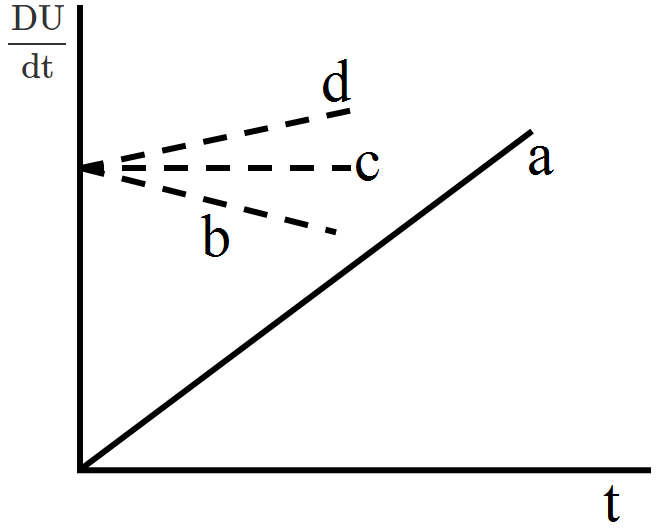
A constant current i is passed through a resistor. Taking the temperature coefficient of resistance into account, indicate which of the plots shown in figure best represents the rate of  production of thermal energy in the resistor.
Answer

  1.  

Explanation:

$\text{U}_{\text{AB}}=\text{a}_{\text{AB}}\theta+\frac{1}{2}\text{b}_{\text{AB}}\theta^2$

$\text{q}\times\text{t}$

$\text{dq}\times\text{dt}$

$Þ \ \frac{\text{du}_{\text{AB}}}{\text{du}}\propto\text{a}_{\text{AB}+\text{b}_{\text{AB}}}\text{t}$

Need a full question paper?

Generate a complete, print-ready paper with questions like this in minutes — across 16+ boards, with answer keys.

Start Generating Free

Similar questions

What is the effect on the acceleration of a particle if the net force on the particle is doubled?
Why can an engine working under isothermal conditions produce no useful work?
What are the two conditions when a real gas follow the ideal gas equation PV = nRT?
A coolie with load on his head is walking on a horizontal plateform. What is work done against gravity?
A tank with a square base of area 1.0m2 is divided by a vertical partition in the middle. The bottom of the partition has a small-hinged door of area 20cm2. The tank is filled with water in one compartment, and an acid (of relative density 1.7) in the other, both to a height of 4.0m. compute the force necessary to keep the door close.
There is a hole in a metal disc. If a metal disc is heated, what will happen to the size of the hole?
What is the basic unit of quantity of substance?
A ball is fired at a vertical hill at a distance $x$ from a cannon aimed at an angle $\theta$ above the horizontal on plane with a nozzle speed $v$. At what height $y$ of the hill from the bottom will the sphere hit?
A sphere can roll on a surface inclined at an angle $\theta$ if the friction coefficient is more than $\frac{2}{7}\text{g}\sin\theta$ Suppose the friction coefficient is $\frac{1}{2}\text{g}\sin\theta$ and a sphere is released from rest on the incline,
  1. It will stay at rest.
  2. It will translate and rotate about the centre.
  3. It will make pure translational motion.
  4. The angular momentum of the sphere about its centre will remain constant.
Give one similarity and one difference between a S.H.M. and a Wave.