MCQ
A constant current is flowing through a long straight conductor, then the graph showing change in produced magnetic field B with distance r is:
- A
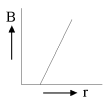
- B
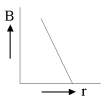
- C
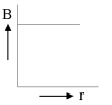
- ✓
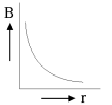
Generate a complete, print-ready paper with questions like this in minutes — across 16+ boards, with answer keys.
It is easier to start a car engine on a hot day than on a cold day. This is because the internal resistance of the car battery
|
(a) Decreases with rise in temperature |
|
(b) Increases with rise in temperature |
|
(c) Decreases with a fall in temperature |
|
(d) Does not change with a change in temperature |
Spherical aberration in a lens
|
(a) Is minimum when most of the deviation is at the first surface |
|
(b) Is minimum when most of the deviation is at the second surface |
|
(c) Is minimum when the total deviation is equally distributed over the two surface |
|
(d) Does not depend on the above consideration |
Intrinsic semiconductor is electrically neutral. Extrinsic semiconductor having large number of current carriers would be
|
(a) Positively charged |
|
(b) Negatively charged |
|
(c) Positively charged or negatively charged depending upon the type of impurity that has been added |
|
(d) Electrically neutral |
A circular loop of radius R carrying current I lies in x-y plane with its centre at origin. The total magnetic flux through x-y plane is
|
(a) Directly proportional to I |
(b) Directly proportional to R |
|
(c) Directly proportional to |
(d) Zero |
Light waves can be polarised as they are
|
(a) Transverse |
(b) Of high frequency |
(c) Longitudinal |
(d) Reflected |
