MCQ
A constant force acting on a body of mass of $5\,kg$ changes its speed from $5\,ms^{-1}$ to $10\,ms^{-1}$ in $10\,s$ without changing the direction of motion. The force acting on the body is  ......... $N$
  • A
    $1.5$
  • B
    $2$
  • $2.5$
  • D
    $5$

Answer

Correct option: C.
$2.5$
c
$a=\frac{v-u}{t}=\frac{(10-5) m s^{-1}}{10 s}=0.5 \mathrm{ms}^{-2}$

As $\mathrm{F}=\mathrm{ma}$

$\therefore \mathrm{F}=(5 \mathrm{kg})\left(0.5 \mathrm{ms}^{-2}\right)=2.5 \mathrm{N}$

Need a full question paper?

Generate a complete, print-ready paper with questions like this in minutes — across 16+ boards, with answer keys.
Start Generating Free

Similar questions

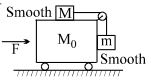
Imagine $a$ situation in which the horizontal surface of block $M_0$ is smooth and its vertical surface is rough with $a$ coefficient of friction $\mu$ Consider a special situation in which both the faces of the block $M_0$ are smooth, as shown in adjoining figure. Mark out the correct statement $(s)$
The node point in stationary wave:
A person is standing on an open car moving with a constant velocity of $30\,\,m/s$  on a straight horizontal road. The man throws a ball in the vertically upward direction and it returns to the person after the car has moved $240\,\,m.$  The speed and the angle of projection
A uniform solid sphere of mass $m$ and radius $r$ rolls without slipping down a inclined  plane, inclined at an angle $45^o$ to the horizontal. Find the magnitude of minimum  frictional coefficient at which slipping is absent-
Two quantities $A$ and $B$ have different dimensions. Which mathematical operation given below is physically meaningful
$Assertion :$ A body that is good radiator is also a good absorber of radiation at a given wavelength.
$Reason :$ According to Kirchhoff’s law the absorptivity of a body is equal to its emissivity at a given wavelength.
A body of mass $6\,kg$ is under a force which causes displacement in it given by $S = \frac{{{t^2}}}{4}$ metres where $t$ is time. The work done by the force in $2 \,seconds$ is ............... $\mathrm{J}$
Choose the correct length $( L )$ versus square of time period $\left( T ^2\right)$ graph for a simple pendulum executing simple harmonic motion.
Consider a uniform wire of mass $M$ and length $L$. It is bent into a semicircle. Its moment of inertia about a line perpendicular to the plane of the wire passing through the centre is :
If $\overrightarrow{ F }=(60 \hat{ i }+15 \hat{ j }-3 \hat{ k })\; N$ and $\overrightarrow{ V }=(2 \hat{ i }-4 \hat{ j }+5 \hat{ k }) \;m / s$, then instantaneous power is