Question
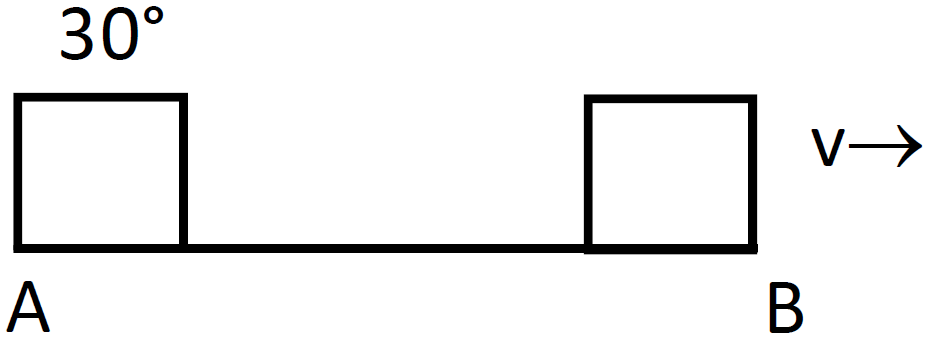
A constant force of 2.50N accelerates a stationary particle of mass 15g through a displacement of 2.50m. Find the work done and the average power delivered.
Answer


F = 2.50N, S = 2.5m, m = 15g = 0.015kg.
So, $\text{w} =\text{F} \times \text{S}$
$\Rightarrow\text{a}=\frac{\text{F}}{\text{m}}=\frac{2.5}{0.015}$
$=\frac{500}{3}\text{m/s}^2$
$=\text{F}\times\text{S}\cos0^\circ$ (acting along the same line)
$=2.5\times2.5=6.25\text{J}$
Let the velocity of the body at b = U. Applying work-energy principle $\frac{1}{2}\text{mv}^2-0=6.25$
$\Rightarrow\text{V}=\sqrt{\frac{6.25\times2}{0.015}}=28.86\text{m/sec}$
So, time taken to travel from A to B.
$\Rightarrow\text{t}=\frac{\text{v-u}}{\text{a}}=\frac{28.86\times3}{500}$
$\therefore$ Average power $=\frac{\text{W}}{\text{t}}=\frac{6.25\times500}{(28.86)\times3}=36.1$

Need a full question paper?

Generate a complete, print-ready paper with questions like this in minutes — across 16+ boards, with answer keys.

Start Generating Free

Similar questions

The count rate from a radioactive sample falls from $4.0 \times 10^6$ per second to $1.0 \times 10^6$ per second in 20 hours. What will be the count rate 100 hours after the beginning?
The potential barrier existing across an unbiased $p-n.$ junction is $0.2$ volt. What minimum kinetic energy a hole should have to diffuse from the $p-$side to the $n-$side if,
  1. The junction is unbiased.
  2. The junction is forwardbiased at $0.1$ volt.
  3. The junction is reverse$-$biased at $0.1$ volt?
Given a + b + c + d = 0, which of the following statements are correct: The magnitude of (a + c) equals the magnitude of ( b + d).
A disc of radius 10cm is rotating about its axis at an angular speed of 20rad/s. Find the linear speed of:
  1. A point on the rim.
  2. The middle point of a radius.
Shows that the projection angle $\theta_0$ for a projectile launched from the origin is given by, $\theta_0=\tan^{-1}\Big(\frac{4\text{h}_\text{m}}{\text{R}}\Big)$ where the symbols have their usual meaning.
The electric field associated with a monochromatic beam becomes zero $1.2 \times 10^{15}$ times per second. Find the maximum kinetic energy of the photoelectrons when this light falls on a metal surface whose work function is 2.0eV.
On what parameter does the $\lambda ($mean free path$)$ depends?
Write the main points of efficiency of Carnot engine.
A 100W light bulb is placed at the centre of a spherical chamber of radius 20cm. Assume that 60% of the energy supplied to the bulb is converted into light and that the surface of the chamber is perfectly absorbing. Find the pressure exerted by the light on the surface of the chamber.
A steel wire of length 64cm weighs 5g. If it is stretched by a force of 8N, what would be the speed of a transverse wave passing on it?